Thursday, 18 June 2015

The Silence.

The world will end neither with a whimper or a bang but in total silence - at least according to Tim Lebbon's new novel The Silence. Well, not total silence as it happens but that's the concept at the heart of this new take on the end of the world.
The harbingers of the apocalypse in this instance are the vesps - prehistoric flying lizards that emerge from a cave in Moldova, unearthed by a scientific expedition. Life in the dark underground has rendered them blind meaning that they hunt their prey by sound alone - which is bad news for the human race whose noisy, modern existence provides food aplenty for the monsters.
In order to remain safe from the vesps, silence must be maintained and it's in this suppression of normal behaviour that comparisons can be drawn with Josh Malerman's brilliant Bird Box. In that novel, mankind had to blindfold itself, rendering itself blind - here the removal of noise to all intents and purposes results in a kind of deafness.
It's no surprise then that Ally, one of the main characters in the book, is actually deaf and it's her families 9enforced) ability to use signing that gives them an advantage over everyone else, living in a silent world is nothing new to them. The narrative focusses on the family's attempts to relocate to the wilds of Scotland, a place of (relative) quiet and hence safety and it's their journey - and their first hand encounters with the worst aspects of humanity - that takes up most of the book.
The opening chapters of the book were the most effective for me. The outbreak is at first reported on live TV but then picked up by social and other broadcast media, describing the inexorable spread of the killing hordes. The tension here is masterfully built with a palpable sense of dread created as the progress of the vesps towards the UK is monitored, and everyone realises that nothing will stop them. Each chapter begins with transcripts of TV and radio reports or blog/social media entries and it's a very effective device, building the tension to almost unbearable levels.
The vesps do reach mainland Britain of course and there the book makes a change in tone, becoming a survival thriller with some brilliantly executed set-pieces.
It's all high-concept stuff but it's a brilliant concept and what results is a tense, exciting and genuinely scary read. It cracks along at a blistering pace and really is a book you won't want to put down. (Though if you do, make sure you do it quietly).
I loved The Silence and heartily recommend it.

Monday, 18 May 2015

The Outsiders.

The Outsiders is the latest publication from Joe Mynhardt's Crystal Lake Publishing and is a collection of five Lovecraft inspired stories written by five different authors set in a fictional gated community called Priory. Priory - and the characters inhabiting it - provides a framing device for the stories but the tales are linked even more closely with the narratives cross-referencing each other, the events of one mentioned in another, characters providing the major narrative thrust in some having cameo roles in others. It's a clever device and one which works extremely well, pulling the five stories together, providing a cohesive whole which is greater than the sum of its parts.
Mind you, the individual parts are pretty good too - the stories work extremely well in isolation but the linking device is a definite enhancement.
The collection opens with The Subprime from Gary Fry (which seems only appropriate - he's doing as much as anyone currently to expand the mythos and create a body of work which provides his own, very distinctive take on it). The story provides an introduction to Priory and its residents, in particular Mr Phillips (Harvey - not Howard) and the enigmatic Charles Erich (whose name will raise a smile for all those students of Proto-Norse linguistics), the community's founder. Phillips is a financier, the respectable face of tyranny as it were and the plot revolves around a crisis of conscience for one of his employees - Lee - who has decided that sacrificing his soul on the altar of capitalism is not for him and decides to tender his resignation. In an attempt to change the young man's mind, Phillips invites him to a dinner party at Priory where it turns out that some sacrifices are actually easier to make than others.
James Everington provides the next story, Impossible Colours which takes the bold step of tackling the subject of Lovecraft's perceived racism. As might be expected from the author, it's done in a subtle, tangential way and very effectively so that the message in no way diminishes the impact, and enjoyment of the story.
Stolen From the Sea is by Stephen Bacon and uses the tragedy of the loss of a child to bring about an awakening in the father as to the true nature of the cult to which he and his wife belong. The cult that is the connecting force within Priory, binding all its residents together. There are few better writers than Stephen at approaching sensitive, sad issues like this (you should read Husks in the Murmurations anthology if further proof is needed) but this is just a starting point for a tense and dramatic escape story.
V H Leslie provides Precious Things, an examination of the deteriorating relationship between two elderly residents of Priory which showcases her trademark skills at story construction and clever wordplay.
The final story is Rosanne Rabinowitz's Meat, Motion and Light which - like James Everington's story - takes the racism issue as its starting point, the story's protagonist a black woman returning to Priory after having escaped its clutches. (Those clutches being undoubtedly tentacular). The old adage of "you can never go home" of course holds true here and things - as might be expected - go horribly wrong. I could be mistaken, but this could be the first story ever to feature a Great Old Ones sex scene. Spectacular love craft indeed.
The Outsiders is a very good book. Five strong stories which provide an excellent homage to Lovecraft and the mythology which is his legacy. Strong enough individually, the stories combine to create something truly special. It's a book I recommend highly and you can buy it here.

Wednesday, 13 May 2015

The Corpse Role.

There was a view, not so long ago, that sales of horror fiction were in decline because many of the tropes the genre employed were being nicked by crime writers - mainstream, best-selling writers at that. That may have been a simplistic explanation but there's certainly an element of truth buried within it. Violent, gory death and psychologically damaged serial killers have become a mainstay of the slightly more "respectable" genre. To be honest, I don't think it's that much of a problem, there's enough room for both genres to flourish and, in a way, it's a good thing for horror to move on, find new themes and tropes to unsettle readers. It's a fine line, I guess, between the two genres and there are many excellent examples of cross-over between the two. Most notable are the Charlie Parker novels from John Connolly but I'll also chuck in a couple of personal favourites, Reaping the Dark by Garry McMahon and Ben Jones' Pennies for Charon as further evidence.
All of which - possibly unnecessary - preamble is by way of introducing a review of a crime novel on a horror review site, namely The Corpse Role by Keith Nixon.
As the title may suggest, mortal remains have a large part to play in the narrative and, indeed, the story begins with the unearthing of a body from a shallow grave. The body turns out to be that of a security guard implicated in an armoured van heist two years previously. A business card from a former policeman, turned private investigator is found in his wallet and so begins a briskly paced, twisting tale of murder, corruption and shock revelations.
The story is told in two timelines - the present involving the ongoing investigation led by DI Charlotte Granger and another (with the chapters titled "the past") which turns out to be the events leading up to the heist. It's a clever technique and one which is executed perfectly. The "past" sections are written in first person, present tense - a device which has the reader constantly questioning who it is that's actually narrating and what, if any, connection they have to the present day investigation.
There's a lot going on in The Corpse Role, and a lot of characters to keep up with. This, along with the double timeframe device, could have easily gotten out of control but it's testament to the author's skill that he marshals everything effortlessly, keeping the plot banging along at a cracking pace and, most importantly, keeping the reader alongside him.
The characters are all well drawn (my favourite a crime boss with a novel way of fertilising his garden) with plenty of realistic dialogue (particularly of the awkward kind between people whose relationship isn't quite what it used to be) which enhance the narrative without distracting from it, or holding it back.
There are twists and turns all the way, and a lovely feeling of things falling into place as the narrative progresses but the biggest revelation is kept to the very end. It's a gamble, using such a dramatic device and the book as a whole hangs on whether it works or not.
It works.
I very much enjoyed The Corpse Role, imaginative, clever and with a no-nonsense writing style it's a book I recommend very much. You can buy it here.

Wednesday, 29 April 2015

The Visible Filth

The Visible Filth is the latest chapbook produced by This is Horror and is written by Nathan Ballingrud. The author's collection North American Lake Monsters was one I was very impressed with so I had great expectations for this novella, expectations which I'm very pleased to report have have been met and, indeed, exceeded.
The story's protagonist is Will who works in Rosie's Bar in uptown New Orleans, a less than salubrious 24-hour establishment, a description of which begins the novella, complete with scuttling cockroaches, subtly setting the scene for what is to come.
The arrival of a group of students brings with it a violent brawl in which one of the bar's regulars, Eric, is wounded, glassed in the face with a broken bottle. Upon the group's departure, Will discovers that one of them has left behind a cell phone which he takes home with him. When he starts receiving text messages on the phone, the true horror begins...
The texts taunt Will but also guide him towards some images - and a video - that are stored on the phone. There are suggestions that the images, via the phone, exert some malign influence over Will, making him open the files but in reality, his decision to do so is probably down to the impulse within us all to look at that which we know will be horrible; the impulse that makes us slow down and crane our necks as we drive past a traffic accident; the impulse that makes us click on the play button of videos showing violent death, beheadings...
Of course, what's revealed in the files is utterly horrible and the author's prose here is perfect, brilliantly conveying the awfulness of what Will sees, transferring the sense of unease and disgust he feels straight into the reader's head. I was put very much in mind of the cursed video from Hideo Nakata's Ringu when reading these scenes, in particular the feeling of unease and dread that the "cursed" video in that film created in me.
There's plenty of disturbing imagery created in The Visible Filth - and the skill with which this is done is one of the story's strengths - much of it will linger in your memory long after reading. As well as this though, the novella presents another masterclass in the depiction of a relationship under strain - something that was also a feature of North American Lake Monsters. Will's relationship with girlfriend Carrie is going through a rough patch and the emotional nuances and dialogue between the two are pitched perfectly.
The Visible Filth is a grim read, one which will make demands of the reader. Bleak and nihilistic, it takes no prisoners and you'll be shaken and disturbed come the last page. Which is about as glowing a recommendation I can make for any horror story.

Tuesday, 21 April 2015

Rogue.

Rogue is an anthology of twenty two stories produced by Near to the Knuckle featuring the titular characters. The stories are set in a variety of locations - wartime London, the USA, the town just down the road from where I live (I kid you not - Northumberland may seem an odd choice of location for a gritty piece of crime fiction but An Imperfect Arrangement by Gary Duncan is set right there) and, in Fish Out of Water by Aidan Thorn, an independent aquarium shop.
The word rogue suggests a rather benign character, a scoundrel or scamp, but the examples on display here are far removed from that definition and the criminals, drug pushers, private detectives and hitmen encountered on these pages provide a wide variety of violent death and torture. There's politics too - though in a subtle, tangential way and even some humour - though of the darkest variety. The latter is most evident in Paul D Brazill's Route 66 and All That which introduces an entertaining set of hapless criminals and contains some zinging one-liners.
Most of the rogues feature here are already established characters before the story begins but a couple of the stories are almost "coming of age"tales wherein extreme circumstances force a character into doing something terrible.
The writing throughout is of a high standard, rising above the pulp origins of the theme and, as might be expected in a book with a definite hint of noir, a third of them are written in a first person narrative. This works well, getting inside the heads of the protagonists but probably the best analysis o the psychology of the villain comes in A Week of Sundays by T. Maxim Simmler in which an escape to the country for a club bouncer makes for some contemplation and an acceptance of his true nature.
I found the first person narrative most effective in Ryan Bracha's Weekend Dad, an incredibly dark piece of writing which provides a nasty twist at the end of a particularly grim story. (It also references one of my favourite albums, El Camino by the Black Keys but that's beside the point...)
There's a detached, dispassionate quality to the writing in Don't Tell by Gabriel Valjan which only serves to intensify the horror of what is happening and which made it one of the highlights of the collection for me.
Horror is precisely the right word to describe what happens in Old Times by Benedict J Jones, a searing destruction of one man's American dream in which petty criminal Danny finds out that his movie and novel generated vision of America is very, very different to actual reality. It's a hard, uncompromising read and one which cleverly deconstructs the glamorous view of the criminal as anti-hero.
Rogue is a fine collection of stories. One or two perhaps out-stay their welcome - this type of story I feel always benefits from brevity, a rapid, punchy style - and a couple mis-fire in their attempts to try and be too shocking. The good far outweighs the bad though and it's a collection I recommend.
You can buy it here.

Monday, 6 April 2015

Blatant Self Publicity.


Tuesday 31st March saw publication of the latest anthology from Charon Coin Press which will feature stories set in (ultimately) all fifty states in America. The state in this instance is Louisiana and the publishers received so many quality stories that the decision was made to produce two volumes in order to incorporate them all.
I'm glad they made that decision because it gave enough space to allow my story Indigo into Volume II. I can't tell you how chuffed I am to have made it to the final selection. Perhaps fate had a part to play in things - I'd already pretty much completed the story before I even knew that the market was open so it was too good an opportunity to miss not to submit. I'm glad I did - editor Jerry Benns is doing great things with the press and the series is taking off in a big way. It was a pleasure to work with him during the editing process and his enthusiasm for the whole process is apparent and infectious.( He has patience too - especially when dealing with prima donna writers banging on about timelines and tenses...)
I'm honoured, and a little amazed, at having been included. It was a bit of a risk writing a story in first person where the narrator is a character so very different to myself (a young, black blues musician in Depression-era America) so I guess it's validation of a sort that I did it well enough to be included in an American publication about a very American subject.
Music plays a big part in the story, was the reason I wrote it in the first place. Music has mystical properties, has its own powers over and above simple enjoyment and was a major force in the time period in which the story is set, bringing people together, providing an escape from the harsh reality that day to day life really was. In Indigo it provides something else too...
By way of appetite-whetting, here are the opening paragraphs. If I've tempted you to read further, you can buy the book (in real or electronic versions) here.


When Lowell Johnson took out his bottle-top slide, closed his eyes and began to play Indigo a hush fell over the room. While his fingers plucked out that twelve bar blues, the glass slid up and down the strings of his dobro like it was greased, bendin’ those notes into somethin’ more than they really was, somethin’ beautiful.

And then he began to sing, still he had his eyes closed, his deep, bass voice growlin’ out the words. It was like everyone was transfixed, hypnotised or somethin’ – the music took them away somewhere, somewhere different for everyone there but someplace good. Wasn’t like he was such a good singer all told, but it was the story he was tellin’, the words themselves, that held us all in rapture. The room was full of smoke and even it seemed to move in time with the music, driftin’ slowly here and there like clouds of ghosts.

He didn’t open his eyes all the way through that song and not for some time after. When he finished, no one clapped –at least for a moment or two, it was like we all needed time to come back from that place he’d taken us to. We did clap though, and the sound gained its own momentum, startin’ slow but buildin’ to a crescendo of noise. Everyone was smilin’, some was even laughin’, and that was somethin’ you didn’t hear a lot of – not in Briersville leastways.

Lowell nodded slowly in appreciation then got up to leave the stage. It was like somehow the playin’ of Indigo had took it out of him. At least that’s how I figured it at the time. Course, now I know the real reason.

Anyways, just a few moments after he’d gone, the whole place erupted back into life, like the moment had never happened. Much enjoyment was had by all, long into the night and, though there was plenty more music to come, none of it came from Lowell.

That was my first ever visit to Creoles and Mr Johnson had played Indigo. Seems like fate was playin’ her hand even then, right at the beginnin’.

Monday, 30 March 2015

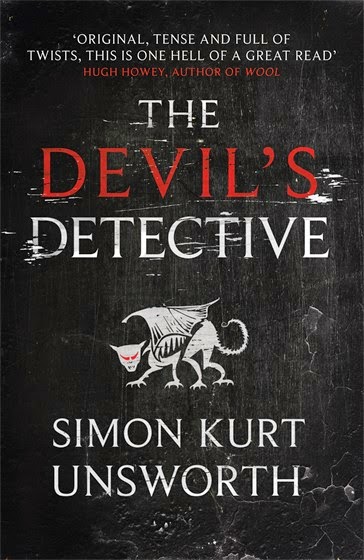
The Devil's Detective.

The Devil's Detective is the first novel from Simon Kurt Unsworth and is published by Del Rey. I've been a fan of Simon's short stories for some time now (his collection Quiet Houses is one I recommend highly) so I was very much looking forward to reading this longer work. Having now finished it, I can honestly say that I found it just as impressive as everything else I've read by the author.
It's high concept stuff, the story (as the title suggests) revolving around Thomas Fool, a detective - or Information Man - working in Hell. Hell may be the destination for the dead but once there, its inhabitants can die again or, more pertinently, be murdered. The investigation of these killings (or, more precisely some of these killings - a triage system operates whereby the majority are simply filed away without being investigated) falls within the remit of Thomas and his companions Gordie and Summer. Throughout the course of the book, Thomas finds his feet, growing into the role. None of Hell's inhabitants know why they have ended up there and this confusion extends into Thomas' job - for much of the time he has no real idea of what it is he is supposed to be doing and the book is littered with self-deprecating snippets of his thoughts, he truly is a doubting Thomas.
The success of the book, of course, depends on how well the author does in creating the world in which the story takes place and it has to be said that Simon has done an outstanding job in this regard. The novel opens with Thomas gazing out over Hell from a vantage point high up, allowing the reader a brief guided tour of the world on display. Brevity is the key though, and the passage does all it needs to do - allowing glimpses without becoming a massive info dump. The places mentioned are visited throughout the course of the book, allowing the detail to be filled in then.
The Devil is in the detail of course, and again, the author has done a great job creating his own vision of Hell. There is much stunning imagery to be enjoyed here, in particular, the scenes of demons fishing souls from the sea of Limbo which washes up against the walls of Hell is one that will linger long in my imagination.
It's clear a great deal of thought has gone into the creation of this world - its inhabitants, with the hierarchical system of demons and humans as well as the locations - and it bears comparison with the imagination which created Discworld and, in particular the city of Ankh Morpork.
The plot itself involves a series of murders in which the souls of the victims have been removed. Fool's investigations bring him into contact with a host of marvellously drawn characters, Adam and Balthazar - a visiting delegation of angels from Heaven, Elderflower the bureaucrat, the Man of Plants and Flowers and so many others. As the narrative unfolds, Fool's confidence grows and the story is as much about his development as a character as the plot of the murder investigation itself (which, it must be said, has an eminently satisfying outcome). As he crosses Hell and High Water (literally) in pursuit of his investigation, Fool becomes a kind of folk hero to the human section of the population.
There's humour here too - a demon guarding the gates to Crow Heights having to stand on a box to see through them - and a lot of it is very subtle. The hospital in Hell is called the Iomante - a Google search of that revealed something that made me laugh out loud. There's plenty horror too though, no punches are pulled in the descriptions of the murders and bad things happen to people, some of which are deeply affecting.
I feel that I can't praise The Devil's Detective highly enough. I'm a big fan of imagination and it's here in abundance, dripping from every page. It's an incredible world the author has created and one which has so much potential for further stories. I sincerely hope that potential is realised.