Showing posts with label review. Show all posts

Monday, 16 February 2026

Monumental


Monumental is Adam Nevill’s new novel and is published by Ritual Limited. Its basic premise is of a trip into the countryside gone horribly wrong; in this instance a kayaking expedition to a “forbidden” valley – private land which includes the estuary leading onto it.

The group committing this act of trespass are Marcus, Mary, Julian, Jane, Nigel and Sophie, the latter two being a married couple. It’s fair to say that none of them are presented as being particularly nice characters, with most of them being a little too self-obsessed to form any real friendships. That said, the relationship between two of them has gone beyond mere friendship in the past – something which creates an added layer of tension on top of everything else which befalls the group.

This group dynamic echoes the one that existed in Adam’s earlier novel The Ritual of course (and which was enhanced by the film version) and, it’s fair to say, that the plot of Monumental bears similarities to that book too. It’s something Adam is well aware of, of course, and is mentioned in the author’s notes at the end of the book and I think it’s probably why he begins Monumental in exactly the same way as The Ritual with a flash forward acting as a kind of mini prologue as a nod to his constant readers.

Whereas the characters in The Ritual found themselves in a dangerous wilderness by mistake, the interlopers here have made a conscious decision to go there, which is perhaps another reflection on their personalities; arrogant and entitled with a “no one tells us what we can or can not do” attitude. I mean, you’d expect nothing less from someone called Marcus or Nigel or Julian. Although none of them wear one on the kayaking expedition, it’s highly probable that at least one of them owns a cravat. Julian even has a ponytail.

 And, of course, the kayakers find a lot more than they bargained for when they enter the valley. This being an Adam Nevill novel, expectations are high for the appearance of a good old fashioned monster and Monumental does not fail to deliver on that front. The latest addition to the pantheon of old gods lurking in the south west of England is a spectacular beast, a move away from the mammalian ancestry of the monsters in previous books to the reptilian. The location in which the action takes place is the Wyrm Valley, a name which gives a massive clue to what the creature is (as well as providing the title of my favourite Stephen Laws novel).

The parallels to The Ritual have already been mentioned but, in a nice universe-building kind of way, the other Devonian creature features get mentions, most notably The Reddening but also Cunning Folk. There’s even a – blink and you’ll miss it (ha!) – nod to Under a Watchful Eye. Having assumed that Old Creel was canine, it was a surprise to find out that The Reddening’s monster was actually a cat: a hyena. (As a dog owner this really shouldn’t have been a surprise to me though, as they are perfect creatures incapable of malice. Cats, on the other hand, are evil incarnate and so a natural choice as a monster). There’s also a nice reference to a classic line from The Night of the Demon which brought a smile to my face.

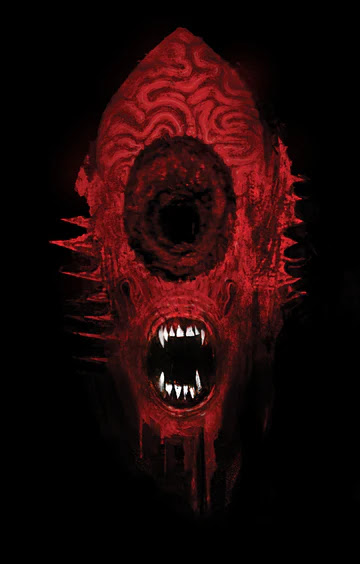
As well as the wyrm itself, the valley is populated by other monsters, the wights, whose bemasked and unmasked features grace the front and back covers of the limited edition hardback courtesy of more outstanding artistry from Samuel Araya. These are the acolytes of the worm, ancient creatures who defend the valley and its otherworldly occupant and whose diminutive stature bears no relation to their powers to terrify and cause harm. An appearance by them towards the end of chapter 25 is a hugely cinematic and nightmare-inducing scene.

There are human monsters too, of course, servants of the god as much as the wights themselves. The Reddening had Tony Willows and his family as villains and here it’s Clement Colman who takes that role. It’s not insignificant, I think, that Colman has made his fortune – thus being able to purchase the land around the Wyrm valley – from investment in and development of AI. A man with no soul in other words, one whose disregard for the creative process and art applies to his attitude towards the people with whom he surrounds himself. There’s a nice parallel I guess between the way he’s made his millions off the hard work and creativity of others and the way he’s seen fit to use the infrastructure built around the ancient worship of the Blood Worm and appropriated it as his own.

So how does Monumental exhibit the Nevillesque?

In spades is the easy answer.

The references to cosmic awe which feature heavily in Adam’s novels are exhibited here not only with regards to the monstrous worm but also to an architectural structure which features in the novel (and which is an overt influence on the book’s title). Described as kiln or cairn-like, the structure is built from stone and surrounded by a ring of timber posts. The build up to its first appearance is impeccably done with a growing sense of dread masterfully created before its ultimate reveal.

Anyone who has stumbled upon a building in the middle of woods will have experienced that atavistic uneasiness that comes with such a discovery and the descriptions of the structure in Monumental vividly recreate those feelings for the reader. Added to this is the question of what the structure actually is – or more specifically what it is used for.

Which is nothing good of course and as such it provides the location for an extended sequence which is amongst the most horrific in the book and in which more elements of the Nevillesque are on display.

The characters who find themselves trapped within the structure find themselves naked and smothered in blood, a direct correlation with the imagery of The Reddening and, of course, a use of the defining colour of Adam’s novels: red, that colour added to by the rays of the setting sun streaming through narrow portals in the building’s side.

This sequence also allows for the author’s use of some of his other trademark assaults on the senses, notably the terrible smell emanating from the structure which is noticeable even outside but so much more pronounced inside, and the lovely (if that’s the right word) use of sound with the noise of something truly awful falling from above to land at the characters’ feet.

The skeletal morphology of so many of Adam’s earlier creations as evidenced in the Blood Friends of Last Days, the Brown Man in Banquet for the Damned and Felix Hessen in Apartment 16 as well as many others is on prominent display in the morphologies of the wights.

So much happens in Monumental that it’s a surprise to realise that the events it describes occur over a time period of fifteen hours. Each chapter gives an indication of what time the action is taking place in e.g. 2-3pm and it’s a device which subliminally provides a sense of urgency to proceedings and reminds the reader that the protagonists are trapped not only by monsters both supernatural and human but also by the tide times which allow them entry and egress from the estuary.

If I’m honest, at times it felt like Monumental was a Greatest Hits compilation of Adam’s previous novels, most notably – as mentioned previously – The Ritual and The Reddening. It’s, as mentioned earlier,  something Adam acknowledges in his notes at the end of the book with this being his third “pagan horror in an outdoor setting” novel. Whilst at first I thought this might be disadvantageous to me fully enjoying the book, those fears soon proved unfounded as, once again, the sheer quality of the writing transported me to the dark places the author had created and I could wallow in the atmosphere, simultaneously rooting for, and maliciously enjoying the ordeals of, the characters.

Is it the most Nevillesque of Adam’s novels? (Taking that title from the critical mass that was The Reddening?)

Maybe.

Whatever, it’s another outstanding piece of horror fiction, packed full of imagery that lingers long after the reading is complete. Three is the magic number, and Adam has created a marvellous triumvirate of Devonian deities thus far but I’m certain that the ancient landscape which is such a strong influence on his imagination will provide the inspiration for many more.

I hope so anyway.

Monday, 4 August 2025

Saving Thornwood


Saving Thornwood
is the new novel from the writing team of David Surface and Julia Rust. It uses the same template as their first novel, Angel Falls, featuring as it does teenagers as protagonists and telling the story via their alternating points of view. Having teenagers as the main characters goes some way to placing the novel in the category of YA fiction but, as someone who hasn’t qualified to be called young for a very long time, and who is still trying to work out exactly what being an adult actually entails, I can confirm that this book can be enjoyed by readers of all ages.

In contrast to Angel Falls, the teenagers in this book exist in different time periods; the sections set in 2022 feature Annie Blake whilst those from 1856 have Mary Donovan as their protagonist. What links them is their connection to Thornwood, a mental care facility in the present day that began life as a full blown “lunatic asylum” back in Mary’s time.

Annie’s father is an activist, working to save Thornwood from closure and redevelopment but whose psychotic break results in him actually becoming a patient there. In 1856, it’s Mary herself who is sent there, along with her brother, abandoned by an uncaring aunt in whose care they resided.

By setting the novel in two different time periods, the authors can present a picture of how mental healthcare has been viewed, and managed, throughout the years. The historic use of asylums as dumping grounds for those whom society can’t be bothered to deal with is a feature shared by facilities both here in the UK and the US. Perhaps the most notorious British asylum was Bethlem Hospital, which opened in the thirteenth century and whose name gave rise to the term bedlam whilst the Virginia State Colony for Epileptics and Feebleminded (a name which displays the general attitude of the time to those with mental health problems it has to be said) which opened in 1910, has earned its own place in the dark history of the US for its practice of sterilising the woman patients there as a form of treatment; eugenics in action. The colony remained open until 2020 despite being the subject of numerous investigations – one as recently as 2008 – and is currently awaiting redevelopment.

A fate of course which Thornwood itself shares, not because of any mistreatment of patients or problems with the quality of care it provides but rather because its real estate value is more attractive than its contribution to the community to those with money, an allusion to the general lack of importance given to mental health issues which unfortunately seems to becoming ever more prevalent these days.

The Thornwood of the 1800s is run by Dr Jonathan Blackwell. Whilst nowhere near as bad as Albert Priddy who destroyed the lives of hundreds of women in Virginia, he’s still a far from ethical practitioner, using Mary’s brother as a bargaining chip in order to force her into becoming a “success story” for the institution whom he can put on public display, an example of how his practices can transform even the most unruly of his patients into a paragon of virtue, all in order to further his own reputation. Mary is certainly feisty and doesn’t hold back on expressing her displeasure. If I have one criticism of the book it’s that I felt that some of Mary’s lines felt a little anachronistic in their delivery but that’s a minor quibble.

With Mary desperate to save her brother, and Annie desperate to help her father (and tacitly prevent another psychotic break) – two young women taking care of their male relatives – the two stories intersect when the two girls meet in the cemetery at Thornwood.

It’s to the book’s credit that no explanation is given as to how this happens. (Although teenage hormones are undoubtedly strong enough to break through the space/time continuum). As a result of the meeting, Annie and Mary find a connection and a friendship is born, one which results in a realisation that they can each help the other with the problems they are facing.

I have to admit that the nerd in me which arises every time I come across a time travel story made their presence known reading these sections of the book. Ever vigilant for the appearance of a paradox, I thought I’d spotted one before realising (with a little help) that this wasn’t really a time travel story at all. Neither of the protagonists travels anywhere (other than, perhaps, to the special place where they meet each other), although they can influence what happens in each other’s timelines. It’s actually more akin to a multiverse/parallel universe/many worlds trope wherein an act or decision made by an individual splits reality into divergent pathways in order that every outcome of that decision van play out.

Probably.

Suffice to say that the altered realities the two girls bring about in each other’s worlds leads to resolutions which uncover a few surprises and secrets along the way.

There’s a lot to like and admire in Saving Thornwood. First and foremost it’s an entertaining read with engaging characters and a plot that has a few surprises along the way. It manages to make many points too without being detrimental to the plot. There’s the aforementioned commentary on the state of mental health provision – past and present – and its concomitant threat of capitalism placing profit before people but it’s about friendships too, and the trust required to build them. Perhaps its most important message though is to highlight the strength and power of the individual. Small acts can have major and lasting consequences; things can be changed, all that’s required is the will to try – and in the current political climate that’s an important thing to remember.

Monday, 21 October 2024

Staggering


Last Night of Freedom
is the debut novel from Dan Howarth whose short story collection Dark Missives and novella Territory both impressed me hugely. It’s set in a fictionalised version (for obvious reasons, as will become clear) of the Lake District and tells of a stag party gone horribly wrong as the men find themselves being hunted by the locals.

The party consists of four friends who, for a variety of reasons, have chosen the remote location for the do. They’re old friends from university who have to some extent drifted apart of the intervening years. It’s a scenario that of course will bring to mind Adam Nevill’s novel Ritual, which featured a similar set of protagonists in a remote, rural location. Indeed, one of the group of four friends in both novels share the name Luke.

Ritual was a novel of folk horror (with touches of the Cosmic) and Last Night of Freedom shares some of those trappings too but it’s fair to say that this aspect plays a background role in things; is there really to provide context. To call it a MacGuffin is probably too strong but the novel is really a character study, an examination of what friendship is. Which is not to say that it isn’t a horror novel – it most certainly is – but the horrors here are of the psychological rather than supernatural variety (with the occasional spot of wince-inducing violence along the way).

This dissection of the relationships between the four men is made possible by the bold move to present the narrative as first person, present tense chapters, moving between the characters in turn. It’s a conceit that pays huge dividends, with the readers exposed, literally, to the innermost thoughts of the men which can then be contrasted with what they say to, and how they interact with, the others. (Two chapters are given over to third person descriptions of two of the local men who are hunting them, something which put me in mind of Hitchcock’s Rear Window in which all but three scenes are from the point of view of L B Jefferies as portrayed by James Stewart).

The stress of the situation the four find themselves in brings to the fore all the resentments and jealousies which until then had been compartmentalised and hidden away. The novel seems to posit the theory that the strength of any friendship relies on how well these negative emotions can be held in check. The four men are fighting their pursuers of course but the tension and mistrust between themselves causes just as many problems.

Last Night of Freedom is incredibly tense. It’s an uncomfortable read and I have to admit to some sense of relief when I’d finished it; not because I wasn’t enjoying it – far from it – but simply because I could allow myself to finally relax. Horrible things happen in this book and the way in which it’s written makes the reader almost complicit in what’s going on. Opinions about the characters will change as the book progresses as the top-notch writing draws you into making your own allegiances. This so done so skilfully that I even found myself rooting for one of the characters after he’d done something devastatingly awful earlier in the book – I’d effectively compartmentalised those negative feelings about him I guess.

It's a novel which works on many levels. It can be “enjoyed” simply as an action adventure but there’s much more depth to it than that. The author’s disdain of the whole ritual of stag parties is evident (even from the book’s “dedication”), a view shared by many, myself included, I’m sure. The opening chapter, told from the viewpoint of Connor, the Best Man, even echoes these sentiments; reflecting the fact that many of those who find themselves participating in these types of functions aren’t actually enjoying it either. “Ritual” is the right word; whilst the book can be read as an attack on toxic masculinity, I think the use of the hunt is inspired, providing as it does plenty of commentary on things being done simply because that’s the way it’s always been. Both protagonists and antagonists here are doing what they’re doing because that’s what tradition dictates.

Not that that’s any excuse of course, but…

I really enjoyed Last Night of Freedom, it’s further evidence that Mr Howarth is a writer to keep an eye on. It’s thrilling, unsettling and food for thought – a combination that’s tricky to get right but which is achieved here brilliantly.

Tuesday, 2 April 2024

All the Fiends of Hell


All the Fiends of Hell is the twelfth novel by Adam Nevill and the seventh to be published by his own imprint Ritual Limited. In keeping with the majority of the books previously published by Ritual, the cover is adorned with another stunning piece of art by Samuel Araya, employing once more their distinctive red and black palette.

The novel begins with an event somewhat akin to the evangelical Rapture in which populations are raised into the sky. However, this turns out not to be a resurrection, with the pure of heart taken directly to heaven to meet God, but rather the first step in an elimination of the human race by extraterrestrial visitors bent on…

Well, there’s the thing. The motivation behind the annihilation is never elucidated because the story unfolds via the viewpoint of Karl – ordinary, unexceptional and directionless as the book’s blurb describes him – a masterstroke by the author as it serves to increase the sense of confusion and dread the events of the first night and then the subsequent days instil in him and, thus vicariously, the readers. There’s no mention here of any government, scientific or military response (although, given the present incumbents of the Houses of Parliament, that response would probably “let’s see if it blows over” or, more likely, “how can we make money from this?”). This limited third person approach is hugely effective, distilling (presumably) global events down to the individual level.

Karl somehow survives the apocalyptic event and there follow a number of hugely atmospheric scenes in which he wanders the now deserted landscapes of his home town; scenes which bring to mind cinematic examples of the same scenario such as the various film versions of Richard Matheson’s I Am Legend, 28 Days Later and, of course, Romero’s Dead films. All of these, of course, have the added bonus of rampaging hordes of monsters added to the mix.

And such is the case with All the Fiends of Hell; bizarre creatures now roam the deserted streets, hunting down those who survived the initial cull in order to kill them. Cue some thrilling set-pieces in which Karl witnesses attacks by the creatures, as well as some “derelictions” in which he discovers the aftermath of the attacks.

The terrifying prospect of being hunted by the monsters is made even more so by the way in which they carry out the killings. Despite obviously having access to the advanced technology which brought about the initial Rapture (and to get into Earth’s orbit in the first place), the hunters resort to physical violence, snapping necks, in order perform their duty. Worse still, the bodies of those despatched are arranged into hideous displays.

This latter suggests a true malevolence to the invaders, an inference that they enjoy the act of killing and are proud of it. Despite its sci-fi trappings, All the Fiends of Hell is most definitely a horror story. Indeed, the original cull of victims also hints at this malevolence despite the lack of violence involved, the novel opening with Karl surrounded by his family, gently encouraging him to join them outside, the implication that something lovely awaits them there…

The horror here is decidedly cosmic. It’s a seam Adam has mined on many previous occasions but Fiends differs from his other novels in that, rather than the horror being confined to an individual or small group of people here it involves the entire planet. This is epic terror. The cosmic awe is skilfully created and enhanced by the imagery of the book; a red pall filling the sky, moving inexorably south and bringing with it the murderous fiends; within those red skies a huge, black object. One can imagine Denis Villeneuve having a field day transferring these visions to film but reading these passages I was put in mind of the apocalyptic paintings of John Martin, and in particular his The Great Day of his Wrath.


(Incidentally, this painting was apparently inspired by a trip to the Black Country, an area of the Midlands not far from where the opening chapters of the novel are set).

Comparisons can be drawn with Adam’s earlier novel Lost Girl. Both are apocalyptic novels – although that event is still awaiting completion in the earlier book – but something else which binds the two together is the theme of a father/daughter relationship. Whereas in Lost Girl, that relationship was a real one, here it’s the bond between Karl and an orphaned girl he discovers on his travels (along with her brother) and who becomes his charge which provides much of the narrative thrust of the novel. When the girl, Hayley, is abducted it becomes Karl’s mission (alongside finding safety of course) to track her down. Much in keeping with Lost Girl, the question of how far he will go to save her plays a big part in proceedings and, as with the earlier novel, the answer is startling – and horrific.

Whilst the scale of All the Fiends of Hell (albeit seen through the lens of individual experience) differentiates it from his other novels, there is still much of the Nevillesque on display here. Descriptions of smells which elicit childhood memories in Karl provide a hugely effective opening to the novel and it’s the distinctive aroma of chlorine which indicates the presence of the fiends. The fiends are classic Nevill creations too, although in many cases their forms are not entirely visible (something which only adds to their strangeness), what can be seen fits nicely into the Nevill template established in his earlier novels. The villain of the piece, Bob – who provides a human element of horror to proceedings – speaks with a heavy accent reminiscent of the scum of the earth the Father came across in Lost Girl and one of Adam’s foulest creations, Knacker McGuire of No One Gets Out Alive.

And, of course, the colour red plays a prominent role, with the ominous pall that covers the sky and marks the progress of the alien invaders casting its ruddy illumination over the world, creating an image of Hell on Earth.

Cosmic awe and existential dread make fine bedfellows and rarely have the two been combined to such devastating effect as in All the Fiends of Hell. Come story’s end the invaders remain as enigmatic and unknowable as they were at the outset, something which only adds to their horror. Whilst the book’s opening played with the idea of faith - the hints at some kind of Rapture type event are overt – the chance of salvation presented here relies entirely upon it, with little more than rumours that the sea offers a means of escape driving the characters to the south coast. It’s a book that in one regard shows the power of the human spirit whilst at the same time demonstrating humanity’s insignificance in the grand, cosmic, scheme of things. It’s a fine addition to Adam’s oeuvre and one I thoroughly recommend.

Tuesday, 24 October 2023

The Good Unknown


The Good Unknown is a new collection of eleven stories by Stephen Volk and is published by Tartarus Press. The collection spans twenty five years of Stephen’s writing career, with the oldest story to feature first published in 1998, and also contains three new stories.

Unrecovered is the opening story and concerns Project Orinoco, a scheme by which ex members of the armed forces are given experience in new trades and skills which they can hopefully use for future employment. The project also has a rehabilitation aspect to it, the participants victims of both physical and psychological trauma resulting from their time in combat zones around the world. In this case, the work experience is an archaeological dig and the story is told in first person narration by Zoe, the dig’s supervisor.

The title of the story is the official term for the bodies of the dead which are left on the battlefield – an account of which occurs within this tale, one rendered in disturbing detail – but, as all good titles are, is applicable to so many other facets of the story. Most notably, it’s a perfect description of the soldiers themselves; traumatised by what they’ve witnessed and still recovering from the impact of those horrors. It’s also applicable to Zoe herself, still in recovery from pre-cancerous changes in her breast, the chemotherapy she is undergoing - and the brain-fuzz it causes - adding a nice note of ambiguity to the scenes in which she catches glimpses of ghostly figures as her relationship with the soldiers, and one in particular, progresses.

Fittingly, the dig unearths a military burial site; soldiers discovering soldiers. The wounds on the excavated bodies are still obvious although only skeletal vestiges remain, a potent reminder that conflict, and its outcomes, has always been a part of human existence.

As the finds are uncovered, so too are the layers of the soldiers’ stories. Subtexts are revealed alongside the subsoil until the ghosts of the ancient past, the recent past and the present come together in a denouement which is as moving as it is profound.

There’s a first person narration in the second story of the collection too. In The Waiting Room that voice belongs to Thomas Frank Heaphy, a painter of miniatures who shares the narrative with a slightly more famous artist of the time, Charles Dickens. The use of real people in fictionalised encounters is a feature of Stephen’s work of course, most notably in his wonderful Dark Masters Trilogy which features Peter Cushing, Alfred Hitchcock and Dennis Wheatley (as well as Aleister Crowley). The Waiting Room has an added air of authenticity by dint of it being based on a real incident; an accusation of plagiarism by Heaphy against Dickens for publishing a story that was identical to one he had himself written based on his own encounter with a ghostly figure in a train.

The story is a marvellously rendered pastiche, the voice employed entirely authentic (with suitably Dickensian names for the supporting cast such as Erasmus Egg) and one which you can imagine being read out in front of a roaring fire at a Gentlemen’s club. The ghost story at its core is suitably creepy but there’s more to it than simply being a spooky tale, with ruminations on art as a psychic ability (whatever the “medium”) forming a discussion between the protagonists. It also has something to say about the power of storytelling, specifically its ability to act as a release, that term used here in a most literal sense.

Three Fingers, One Thumb is the third story in the collection and continues the trend set by the first two with its first person narration. This is the story which was originally published in 1998 – making it the oldest of the collection – and it’s also the shortest, coming in at under 1500 words.

It’s also the first story of Stephen’s that I read (though probably a few years after its initial publication). I remember how impressed I had been at the time, amazed at how much could be achieved with such a small word count and my feelings about it reading it again are exactly the same.

This is a truly wonderful short story. Its construction is brilliant; setting the scene in the first couple of paragraphs before tracking back in time to provide a back-story that tells you everything you need to know about the protagonists before a lovely segue returns you to the here and now and the drama which is about to unfold. The skill of the writing which precedes it means that the final line is landed perfectly. And what a line it is, the horror of its implication hitting you not once, but twice. Masterful stuff.

First person narration #4 is brought to you by the next story, 31/10. In about as meta a way as you can get, the narrator turns out to be Stephen himself, here to tell all about the making of Ghostwatch 2, Return to Studio 1.

Which, of course, never happened.

Or did it?

No, it didn’t. But, given the whole controversy over the original Ghostwatch was due to people thinking it was real rather than scripted and acted, it seems only fitting that this story should play on that motif, presenting itself as reality rather than fiction.

Reality being a key word. It’s fair to say that this story is an attack on the vacuousness of modern TV programming, (the story was written in 2006 but things have not improved, have actually even gotten worse, since then), with its reliance on “Reality” shows rather than original drama. Indeed, Ghostwatch 2 is pitched as a reality show, with celebs (including the author himself) returning to the studio where it was filmed with cameras there to record what happens.

In much the same way that the upbeat The Sidewinder Sleeps Tonite feels out of place amid the otherwise melancholy atmosphere of REM’s Automatic for the People album, so 31/10 feels a little out of step with the rest of the collection with its sardonic humour and, it has to be said, a fair bit of venting by the author. That said, it is hugely enjoyable and is, again, a very cleverly constructed story which mirrors the original Ghostwatch with its slowly accumulating horrors leading to a dramatic climax.

The Good Unknown, the story which gives the collection its title, breaks away from the first person narrative format into third person, allowing access to both of the tale’s protagonists; veteran actor Karen Berg and Davy Praed, making his film debut alongside her.

Plucked from obscurity, this (major) role makes him the “unknown” but, as with the opening story Unrecovered, there’s much more that can be read into the title. This story is very much a meditation on death – the last great unknown – a key scene in the film being Praed’s character’s suicide, the filming of which is preceded by a discussion on his motivation for carrying out the act.

In common with The Waiting Room, there are also insights into art and its creation. At one point Karen remembers being told “art has to have a pattern because life does not,” and during his audition, Davy is told to stop reading the book on which the film is based: “Read the script. The book won’t give you any answers. The book is just reality.”

That’s an important “just”. The previous story, 31/10, made no secret of its opinions on “reality” TV and the way in which it erodes the concept of creativity. Art is hugely important; it allows us to explore concepts and emotions which the strictures of real life prevent. The film being made is based on real events but it’s the creative flair of the writer, director and actors which will bring it to life.

And death, of course.

The Flickering Light introduces us to Piet and Bell, who are hosting a dinner party for their friends. Demis Roussos’ Forever and Ever might not be playing on the home stereo but there’s a definite Abigail’s Party vibe to this story, exposing as it does the shallowness of the middle class supping their prosecco and consuming artisan bread from the local bakery. In an extension of the art/reality theme which has run through the preceding stories, there’s a real sense that the characters here are playing parts. Lacking the skill or imagination to create their own versions of themselves, to be individuals, they have instead become stereotypes; the ageing hippy Hilton in his Hawaiian shirt, the “fashionably late” Jacquetta in her faux fur coat.

The superficiality and artificiality of their personas means that those characteristics apply to their relationships too, most significantly in the case of Piet and Bell. At one point “he demonstrated smiling”, a sentence which perfectly describes his character. Which is a controlling one. (Perhaps Piet is a reference to Piet Mondrian, best known for his geometrical designs in which everything is neat and tidy and in its place).

Of all of them, it’s Bell who is the most grounded and “real”, also the most romantic and imaginative, willing to accept the supernatural provenance of the flickering light inside the house (which Piet has designed), despite the cynicism of the others when she attempts to explain it.

The flickering light can be seen as a metaphor for her and Piet’s relationship of course, on the brink of extinguishing completely but there’s also the possibility that it’s one Bell is glimpsing at the end of a tunnel.

Hojo the Fearless is set in feudal Japan and is a related in the form of a fable. In it, the titular character, a samurai, is sent by the Emperor to the village of Orobi whose inhabitants are under siege by a plague of ghosts. (Hojo’s reputation is obviously such that the standard seven samurai are not required). Unfortunately, Hojo turns out to be arrogant and hubristic, qualities which only serve to make the situation worse both for the villagers and himself.

Fables are, of course, wide open for interpretation. The story was originally written – or at the least published – in 2009 but it’s proved to be an eerily prescient commentary on the state of British politics in recent years; an arena in which individuals are given responsibilities merely as a result of their privileged backgrounds, individuals who are completely unsuited for those responsibilities and whose arrogance, laziness and complete lack of dedication to the job result in catastrophe for those whose safety and wellbeing they are in charge of.

Baby on Board is told from the point of view of a police officer who discovers a car parked dangerously by the side of the road. On further inspection he discovers the driver, a young man, still inside and, seeing how tired and drawn he is, gets him to agree to having a coffee at the nearby service station. The story then unfolds via the conversation between the two men, a technique Stephen also used (brilliantly I have to say) in his story The Peter Lorre Fanclub.

It's a hugely effective way of doing things, especially when executed as skilfully as this is, making readers feel as if they’re sitting at the next table, eavesdropping. In a book full of ghosts, this is perhaps the most haunting of them all.

The spirit of M R James is well and truly evoked in the next story, Cold Ashton. Set in the 1940s, it features an academic finding themselves in the remote, rural location which provides the story’s title who, in the course of researching the village’s peculiar name, uncovers dark secrets from the past. It’s by far the most traditional story in the collection with its taciturn locals, tales of dark deeds unearthed in the parish records and a hugely authentic voice employed to pay homage to the authors of horror’s golden age.

There’s an authenticity too to the research presented within the story, the instances of witchcraft, shapeshifting and deviltry which took place in and around the village presented, in typical sixteenth century style, as simply a matter of record and when the explanation for its name is finally revealed it creates a genuine shudder.

In the same way that 31/10 provided a sequel of sorts to the TV show Ghostwatch, so the next story, Lost Loved Ones does the same for Afterlife, also created by Stephen, which ran for two series in 2005 and 2006.

It’s by far the longest story in the collection – novella length in fact – which I imagine would be the equivalent of a single episode of the TV series were it to be filmed. It begins with the death of Alison Mundy’s father, she being the main character of Afterlife, a psychic with the gift (or curse) of being able to see the spirits of the departed. Her trip to the hospital brings her into contact with one such spirit, a man dressed in motorbike leathers and it’s her investigation into him that provides the narrative of the story.

Reconciliation with death was a major theme of the Afterlife series, something which pertained to the main characters as well as those whose stories made up the fourteen episodes and that’s also the case here. Whilst the death of her own father was expected, that of the young motorcyclist was not but will the reasons for his “haunting” prove to be a simple unwillingness to move on or are there other forces at play?

There’s a foray into second person narrative (a favourite of mine) for the final story The Crossing. The “you” to whom the story is addressed is Dylan, a troubled teenager reluctantly participating in a family holiday to Dungeness.

It’s a coming of age story with the title possibly referencing the transition from childhood to adulthood but there’s another, more literal, interpretation given that the location of the story, on the south-east coast of England, lends it proximity to the ongoing tragedy of the small boat crossings of the Channel. Political rhetoric has reframed it as a threat, a ploy willingly accepted by the feeble of brain, a distraction, completely ignoring the real horror of the situation for those involved.

The now famous image of a young child washed up dead on a beach features heavily in the story, an image which comes almost to obsess Dylan, haunting his thoughts and actions, his own personal journey becoming inextricably linked to the final one taken by the boy.


To one extent or another, the stories in The Good Unknown are all ghost stories. Actual apparitions appear in six of them but even in the remaining five the characters are in some way haunted by past encounters or experiences. In Lost Loved Ones, Alison opines that “ghosts were the natural consequence of the brain trying to make sense of what it saw,” – not real entities but images created by the mind as a coping mechanism. It’s an interesting perspective and this collection as a whole would seems to suggest that the emotion that is most likely to create this mechanism is grief – “...the perpetual human condition. It’s a given. A constant,” as Alison also believes.

Grief and loss infiltrate almost all of the stories here, along with the need for closure for those who are haunted by it. Lost Loved Ones may be the title of only one of the stories but as a theme it prevails in many of them, most strikingly when those lost are children – a feature of The Waiting Room, 3 Fingers, 1 Thumb, indirectly in The Crossing and perhaps most movingly in Baby On Board. That desire for closure provides the narrative thrust of these stories; sometimes it’s obtained, sometimes not although both outcomes provide their own horrors along the way.

This is another outstanding collection from Stephen Volk. In a review of his work many years ago I called him a master craftsman and it’s an assessment I stand by, and one which is reinforced by the stories in The Good Unknown. It’s a book I heartily recommend.

Tuesday, 1 November 2022

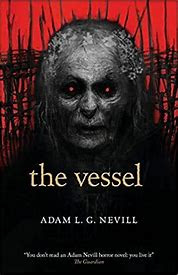
The Vessel


The Vessel is Adam Nevill’s eleventh novel and the third to be published by his own imprint Ritual Ltd. In keeping with those previous releases, the book features amazing cover art courtesy of Samuel Araya (with the hardback once again giving the image the prominence it deserves by omitting the title from the cover); a truly unsettling portrait of an old woman, rendered in the now familiar red and black palette which is a trademark feature of the Ritual covers.

The story concerns care worker Jess McMachen (no prizes for guessing from where that surname derives) starting a new job at the wonderfully named Nerthus House (an eminently Google-able name whose derivation will offer tantalising titbits about what is to come), situated in the village of Eadric - the outskirts of which provided the location of Adam’s previous novel Cunning Folk - there to look after the former vicarage’s resident, the elderly and disabled Flo Gardner.

Anyone who has watched Rose Glass’s hugely impressive directorial debut St Maud will find these opening scenes familiar, but once the scenario has been established, the stories which follow are very different. From the off, it’s obvious that there is something not quite right about Flo; wheelchair bound and virtually comatose, the arrival of Jess – and in particular her daughter Izzy – seems to bring about a reawakening in the old woman and with it the formation of a bond between her and Izzy.

Clues are subtly woven into the narrative to suggest Flo’s true nature. Small shrines, pagan in nature, are discovered by Jess scattered around the house and Flo invokes the name of Erce – an Anglo-Saxon earth goddess. When talking to Izzy Flo uses the wiccan phrases “merry meet” and “merry part” rather than a simple hello or goodbye.

In common with a number of Adam’s female characters, Jess has a troubled past in the shape of a violent ex, Tony. His re-entry into the new and better world Jess is trying to create for herself and Izzy acts as a catalyst for the action of the novel, setting into motion a terrifying sequence of events; ones which find a resonance in the dark history of Nerthus House.

We’re well and truly in folk horror territory here, in keeping with the previous two Ritual Ltd novel releases The Reddening and Cunning Folk and the feeling of dread at what must surely, inevitably happen mounts and mounts as the narrative progresses. There are echoes of Adam’s earlier novel House of Small Shadows here, with a young woman being drawn into, and under, the influence of a house’s elderly resident but whereas in that earlier book it’s Catherine, the protagonist, who is the victim of Edith Mason’s malevolence here it’s Jess’s daughter Izzy who falls under the spell (possibly literally) of Flo, with some kind of connection being made between the young girl and Flo’s own daughter Charlotte who died as a child.

The Vessel features all the genuine creepiness and disturbing imagery readers have come to expect from one of Adam’s novels and its narrative of folk horror, ritual and ancient gods marks it out as archetypal of his oeuvre. At the same time, however, it is very different indeed to his other books – that difference being the way in which the novel has been constructed and written. Like Cunning Folk which preceded it, The Vessel began life as a screenplay but whereas the former was adapted and added to in order to make it more novelesque, what we see and read in The Vessel is pretty much the film as it would play out on screen presented on the page.

Changes have been made of course, the book does not read as a screenplay with attributed dialogue interspersed with paragraphs of action direction but, compared to all of Adam’s novels, this is a slim volume indeed, clocking in at just under 150 pages. The reason for this brevity is that – because this is a representation of what would be seen on screen – all inner monologues and pages of introspection describing the protagonists’ inner thoughts and emotions have been stripped out. Any clues as to what the characters are feeling or thinking come solely from what is seen and heard by them.

It's a bold move, and one made possible by the author having full creative control over his work, something which allowed the “experimental” collection of short stories Wyrd and Other Derelictions, stories in which there were no characters at all. Wyrd worked brilliantly, (and I still believe that the format of the derelictions should be regarded as a new sub-genre), and it has to be said that The Vessel is equally successful in achieving what the author set out to do.

I have some reservations of course; one of the things I find most impressive in Adam’s writing is the tension he creates and then maintains (see The Ritual and No One Gets Out Alive in particular). Much of that tension arises from getting inside the characters’ heads of course, something which doesn’t happen here and, while there are scenes within The Vessel that create their own tension what we have here is a much faster paced read which rattles along from one chilling development to the next.

That said, the characters in The Vessel are far from cardboard cut-outs, simply there to progress the plot. They are all of them fully formed and Jess’s backstory is more than adequately explained. In true cinematic style, using visual clues, her current and past experience is summed up in a single line:


With fingers reddened by cleaning agents, she habitually worries an old scar that cuts her top lip and extends to her nose.


As succinctly as that, light is thrown on Jess’s relationship with her ex, Tony, giving an insight into his character even before we meet him, painting a picture of him in readers’ heads that manifests as unease whenever he appears.

There are a number of visual references to circles in the novel too; the window above the door of Nerthus House, hand gestures made by Flo, even the layout of the village of Eadric itself, all of which play into a notion of circularity, of wheels both literal and metaphorical slowly turning, of ends becoming beginnings – history repeating itself.

The cinematic style and form of the novel is reflected in its short chapters, each representing a scene in the film that would have been. As the book hurtles towards its climax there’s even rapid cutting between action in different locations within a scene. At one point, there’s even the literary equivalent of a jump scare, a sudden jolt of action and sound (yes, sound) that managed to startle me. I have to say that it’s a device I hate in films but I was certainly impressed by this one. There’s a nice use of bookending too, a sequence which opens the book closes it too, a fitting use of the technique given the motif of circularity which runs through the narrative.

I enjoyed The Vessel very much. It’s true that I missed languishing in the Nevillesque for an extended period of time (I polished it off in two sittings) but the skilful way the narrative has been constructed here is impossible not to admire. It’s refreshing to see an author refusing to rest on their laurels and try different things, especially when those efforts result in something as clever and entertaining as The Vessel.


Monday, 25 October 2021

Cunning Folk


Cunning Folk is the new novel from Adam Nevill and the second published by the author’s own imprint Ritual Limited. As with all previous Ritual publications, the book itself is a thing of beauty with another stunning piece of artwork from Samuel Araya gracing the cover. The hardback edition is particularly striking, following the precedent set by 2019’s The Reddening by omitting the title and giving full exposure to a monstrous visage, in this case a terrifying boar with curved tusks and glaring, red eyes.

The book’s protagonists are Tom and Fiona who, along with daughter Gracey and dog Archie, are moving into their new home, a house they’ve bought after years of living in rented accommodation. A new start awaits them all, an escape from unscrupulous landlords and the grim existence of life as tenants…

OK, it’s clear from the start what kind of story this is going to be. Even if it weren’t for the hugely effective prologue to the book, in which the fate of the house’s previous owner is revealed, savvy readers will realise that things “probably” won’t be going to plan for the family, and that their dream of a new life will instead be a nightmare. The trope of the “moving into a new house unaware of its dark and secret past” is far from new but – I have to admit – is a particular favourite of mine, particularly if the properties are in remote, rural locations. To his credit, Adam gives a nod to this early on in the book during a game of I-Spy as the family approach the house. “Something beginning with H” elicits both “home” and “haunted house” as replies.

Sinister dwellings have of course featured in Adam’s books before, most overtly in Apartment 16, House of Small Shadows and the recently screen-adapted No One Gets Out Alive (which expands hugely on the aforementioned horrors of living in rented accommodation). The challenge then, was to see if he could come up with something new on the theme, a challenge I was fairly confident he would rise to given his recent invention of a whole new sub-genre with his amazing Derelictions.

My confidence was not misplaced. After carefully arranging all the pieces to set up readers’ expectations, Adam skilfully pulls the rug from beneath their feet and gives us something else entirely.

The house is in a state of decrepitude, something which gives Tom the opportunity to flex his DIY muscles as he learns the art of being a “home owner”. Unfortunately, despite the overwhelming sense of pride and achievement the act of laying a single piece of lino in a room brings with it (yes, I speak from personal experience), things turn darker for Tom. It soon becomes obvious that the house requires a  huge amount of work – something that will cost money the couple do not have; Tom is freelance but currently with no contracts whilst Fiona works in a bank. This introduces a tension into their relationship, a tension which is exacerbated by the introduction of the book’s other main characters, Tom and Fiona’s next door neighbours the Moots.

The Moots are wonderful creations, and it’s clear from the start that something is decidedly “off” about them. Adam has a real gift for describing the weird and such is the case here. The neighbours not only have a distinctive appearance, their behaviour is also somewhat unsettling; visitors to their property appear to interact with them in a way that suggests obeisance, as if the Moots have some power and control over them. Whilst this is strange enough, it’s their proprietorial attitude to their own property – and the land around it – that brings them into conflict with Tom.

The “that’s not how we do things around here” sentiment is one familiar to anyone moving into a new area, a manifestation of the belief that ownership and control are somehow part of the act of simply living in a place for some time. The Moots, however, take this concept to its extreme – and some of the things they do do are very strange indeed.

The book is mainly told via the viewpoint of Tom but it’s a clever move on the author’s part to describe the first of the truly bizarre set-pieces through the eyes of Gracey who has wandered into the woods behind the house. There, she comes across a clearing and witnesses a strange ritual being performed by the Moots. Through her innocent eyes, the activities on display are strange but in a funny way; to the readers’ eyes of course, they are something else entirely.

Grotesqueries are stock in trade for Adam and the manifestations within Cunning Folk are a fine addition to his monstrous menagerie. Those whose childhoods were traumatised by the TV show Pipkins will have their nightmares rekindled here and there’s  more than a passing reference to the author’s short story Pig Thing.

Conflict, inevitably, arises between the two households and, as the paranoia and tension increase, so Tom’s behaviour becomes ever more extreme. The ratcheting up of hostilities is cleverly done, a contrast being drawn between the seemingly calm and controlled Moots and the increasingly erratic Tom. The narrative raises the possibility that all this is in Tom’s head of course, something that clearly occurs to Fiona whose frustration with her husband further exacerbates the tension that is already there between them.

Whatever the driving force behind the conflict, it culminates in a scene which is possibly one of the most disturbing Adam has ever written. Which is saying something. The scene brings things to a head, and ushers in the third act of the book in which revelations abound and a whole new context is placed on events.

Cunning Folk is adapted from Adam’s own screenplay – something which is reflected in the present tense prose of the novel. (Lines like “Tom picks up the chainsaw” work in both formats). This is something which both benefits and detracts from the narrative. The need to condense the story into what would be ninety minutes on screen (or 120 if there’s a bigger budget…) means that the narrative cracks along at a fair old pace. Short chapters reflect short scenes on film. Whilst this is a positive (“it’s a literal page-turner!”) it also means that there’s some loss of tension. Both The Ritual and No One Gets Out Alive are supreme examples of the author creating – and, more importantly, sustaining – incredible amounts of tension but I felt that was lacking a little in Cunning Folk. Both those books have of course been made into films and whilst The Ritual movie managed to recreate some of the tension of the book, No One Gets Out Alive – whilst being hugely entertaining in its own right – had no chance to do the same, having reduced the original 600 plus page novel into a swift 85 minutes running time.

It could be argued that this “need for speed” sacrifices the time for character development and, indeed, it often seems that Fiona simply acts as a foil for Tom. The story really is Tom’s however, it’s his actions and reactions that drive the narrative - and Adam does have a very good track record for having strong, female lead characters in previous novels.

These are minor quibbles anyway. The characters are still well drawn enough for you to care about them and what happens to them – which makes “that” scene all the more impactful. Whilst I delighted in the longueurs of many of Adam’s previous works, immersing myself in the worlds he’d created, I really enjoyed hurtling through Cunning Folk – in fact the change in pace from previous works is testament to his versatility. And to be left wishing there had been more is no bad thing either…

Cunning Folk is, well, cunning – playing with readers ‘expectations throughout. It’s a potent blend of psychological and folk horror with a hefty dose of violence added to spice things up. The conclusion, reached via an action-packed third act, is deeply satisfying – which is a description I can apply to the book as a whole. It’s further evidence (were it needed) that Adam Nevill remains at the forefront of contemporary horror fiction. Long may that situation continue.

Thursday, 30 September 2021

CYASAWEMWN?


CONGRATULATIONS! You’ve Accidentally Summoned a World-ending Monster. What Now? is the latest offering to spring from the loins of author Duncan P Bradshaw, those same loins which have already produced a number of books with really long titles. Like the best marmalade, the book is thick and chunky, the spine of the paperback alone is an incredible one inch (24mm) wide and the volume weighs in at an impressive 17oz (482g). If these amazing statistics alone aren’t enough to convince you to buy it (bear in mind there’s a kindle version too but it’s difficult to make any kind of anthropometric measurement of a virtual medium - but let’s say it’s 21g which is the weight of a hummingbird or a human soul) then maybe the words inside will be.

There are loads of them, verbs, nouns (some of them proper), adverbs (I know!) and adjectives – all arranged in an order which makes them instantly readable and sometimes hilarious. The most important word in that sentence, of course, was “order” because that’s the key to enjoying this book to its fullest, is indeed the principle upon which it has been created/extruded from loins. The thing is, the reader themselves decide on the order in which the pages within are read!

I know, this is a major dereliction on behalf of the author; reading books is supposed to be relaxing, an activity done for pleasure and here we are having to do ALL the work. There are however, ample instructions as to how this might be achieved; at the end of some sections a choice is presented to the reader as to which page to go to next, each of which will lead the story down a different path. (In the kindle version, this is achieved by the use of hyperlinks like this one). It’s a clever concept and one which – if it hadn’t been for Edward Packard coming up with the idea of the Choose Your Own Adventure books – would be totally unique. Readers who manage to ignore the feelings of paranoia born of wondering if they’ve chosen the right path and stressing over whether they’re going to be lost in a never-ending maze within the book will enjoy themselves greatly, following the eclectic bunch of characters to not one, but TEN different endings. The challenge of course is to find them all, and minimise the number of times you say “bollocks, I’ve been this way before”. As an added bonus, there’s a hidden section which will take the (crafty clue-solving) reader into a completely different realm (not literally) in which they will uncover – shall we say – stories within the story…

As to the plot… well, the title pretty much sums it up and to be honest, I can’t be arsed to review ten different stories. It is hugely entertaining though, with lashings of the trademark Bradshaw humour and surrealism with enough fourth wall breaking to satisfy even the most ardent and critical aficionados of postmodern metafictional mucky jokes.

Joking aside, the book truly is a wonder to behold. It’s mind-boggling to contemplate the amount of work that must have gone into producing it. It’s an amazing achievement and one which has been pulled off with aplomb (see mucky jokes above).

I loved the time I spent wandering around aimlessly in the dark corridors of this book. In the best traditions of GoreCom, it will have you laughing out loud one moment and stifling a gag reflex the next (sometimes simultaneously actually). It could well be the author’s finest hour (or minute if you choose ending seven).

By way of homage to the book and its central theme of “be careful playing word-based games, you never know what might happen” and also to a key character who – despite only warranting a couple of sentences – provides the beating heart of the novel, here’s a wordsearch puzzle containing a number of key themes from CONGRATULATIONS! You’ve Accidentally Summoned a World-Ending Monster. Which you should buy. Now.


Wednesday, 5 May 2021

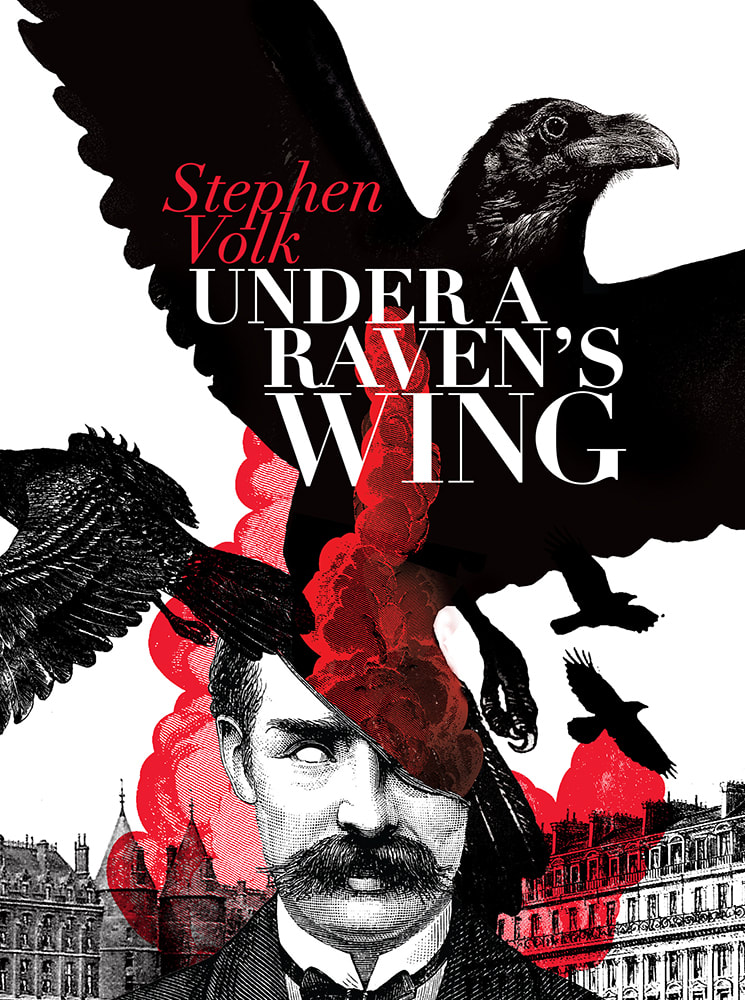
Under A Raven's Wing.


Under A Raven’s Wing
is a new collection of stories by Stephen Volk and is published by PS Publishing. The seven stories contained within this beautifully produced book describe the exploits of a young Sherlock Holmes and his tutelage, in the Paris of the 1870s, by another famous fictional detective C. Auguste Dupin. It’s a marvellous concept bringing together the two men - the veteran and the rookie - with the old master passing on his knowledge and wisdom to the young man at the beginning of his career, and something Sir Arthur Conan Doyle would heartily approve of I’m sure, having acknowledged his own debt to Poe’s detective when creating the character of Holmes.

All of the stories bar one are presented as letters from Holmes himself to Inspector Lestrade, written as the master detective nears the end of his own life; a neat inversion from the original stories in which the narrator was Holmes’ partner in crime(busting) Dr Watson. The final story, the incredibly poignant The Mercy of the Night, is the only one not to follow this format – except it sort of does. The bulk of the narrative is a letter from Dupin to Holmes – which finds its way to Lestrade nonetheless, courtesy of Holmes himself who adds his own correspondence as a coda, giving the whole thing the feeling of a story within a story, a dream within a dream.

I confess, the last sentence of that paragraph was a desperate attempt on my behalf to shoehorn a Poe reference in. And pretty awful it was – unlike those that are distributed about the book itself. There’s much joy to be had at spotting them – some are more obvious than others – and they’re an indication of just how much work has gone into producing these stories. The level of detail is astounding, in particular the recreation of the voices of the two fictional detectives both of which ring absolutely true.

With his wonderful Dark Masters Trilogy, Stephen showed himself a master at placing real people in fictional situations to produce compelling stories and insightful character studies. In Under A Raven’s Wing, he’s flipped that around, placing two fictional creations in real historical settings, populated by real people – including Jules Verne – and set against real events such as the dedication of the Statue of Liberty (a scene in which I believe I spotted an uncharacteristic lapse in the accuracy of Holmes’ recollections…) Jack the Ripper flits through one of the stories but there are nods to famous fictional characters too; the Phantom of the Opera and the Hunchback of Notre Dame also get honourable mentions.

There’s great skill employed then in the creation of this fictional/real world but the key to the success of any crime fiction – which is what this is after all – is in the plots themselves, the crimes which have to be solved. Once again, the author has come up trumps; the mysteries here are ones Poe and Conan Doyle would have been proud of creating themselves – seemingly impossible crimes which are solved by the characteristic application of logic and rationality. Whilst Holmes might be the main subject of the book, the nature of the mysteries he and Dupin solve owe more to the latter’s creator, most strikingly in Father of the Man which involves the plot device of a premature burial (and which is my favourite of the collection).

In truth, the book is an origins story, telling as it does of the apprenticeship of Holmes. As such, it does a marvellous job of inhabiting the character and even provides explanations for, and origins of, many of the great detective’s trademarks; the magnifying glass, the violin – even his drug addiction.

I really can’t express how impressed I was with Under A Raven’s Wing. The stories in here are some of the best to feature the character of Sherlock Holmes that I’ve read – and bear favourable comparison to the originals. It’s proof yet again that Stephen Volk is one of the most creative writers currently plying their trade and also one of the most skilled at his craft. It’s a book I recommend highly.

Monday, 15 February 2021

There Goes Pretty


There Goes Pretty
is the latest novella from Dark Minds Press, the eighth in the series. It’s penned by C. C. Adams, an author whose work I’ve enjoyed in the past (and who featured a favourite monster of mine in his earlier novella But Worse Will Come).

It tells the story of the relationship between Denny and Olivia and opens with their wedding at Shakespeare’s Globe in London. As the couple begin their new life together, so the cracks begin to show – more than the to-be-expected frictions of living together though, there is an external agent interfering with their plans.

A feature of all Of C. C.’s writing has been the excellent characterisation he produces and There Goes Pretty is no exception to this. All the characters within are well formed with traits and habits which ring true. The relationships between those characters is another strength of his writing and this is definitely to the fore here. The interplay between Denny and Olivia and the mistakes they make (with the associated over-thinking) will be familiar to anyone in a relationship.

With the groundwork done establishing the characters and their relationship (and with only a little foreshadowing), the supernatural elements of the story are introduced about a third of the way into the novella. I have to say that the two main scenes in which this happens are extremely effective, generating a real sense of terror and panic.

They’re effective too in the way they fit into the narrative, happening when the couple are apart, casting an air of ambiguity over them and leading to a situation where trust becomes a major issue for the newly-weds.

As the relationship deteriorates, so the rationale for the strange events is revealed. Whilst I was cool with the reveal I did feel that it could have been done in a more dramatic way than it is here, there’s no real “wow” factor to the revelation.

The book rallies for a strong, and clever, finish though – one that nicely plays with the themes of friendship, loyalty, trust and love which have run through the book.

I liked There Goes Pretty very much; it’s further evidence of an author on the brink of big things and a fine addition to a fine range of novellas. Once again the stunning artwork featuring the characteristic red/black colour scheme is provided by 77Studios.

You can buy There Goes Pretty here.