Monday, 30 March 2015

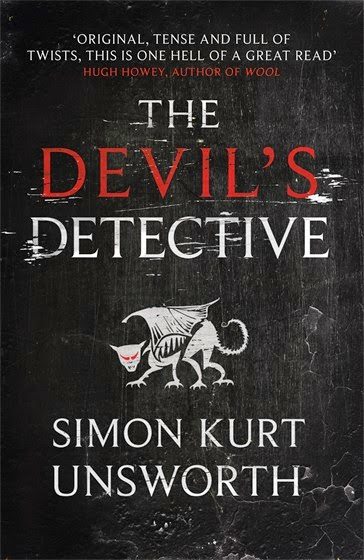
The Devil's Detective.

The Devil's Detective is the first novel from Simon Kurt Unsworth and is published by Del Rey. I've been a fan of Simon's short stories for some time now (his collection Quiet Houses is one I recommend highly) so I was very much looking forward to reading this longer work. Having now finished it, I can honestly say that I found it just as impressive as everything else I've read by the author.
It's high concept stuff, the story (as the title suggests) revolving around Thomas Fool, a detective - or Information Man - working in Hell. Hell may be the destination for the dead but once there, its inhabitants can die again or, more pertinently, be murdered. The investigation of these killings (or, more precisely some of these killings - a triage system operates whereby the majority are simply filed away without being investigated) falls within the remit of Thomas and his companions Gordie and Summer. Throughout the course of the book, Thomas finds his feet, growing into the role. None of Hell's inhabitants know why they have ended up there and this confusion extends into Thomas' job - for much of the time he has no real idea of what it is he is supposed to be doing and the book is littered with self-deprecating snippets of his thoughts, he truly is a doubting Thomas.
The success of the book, of course, depends on how well the author does in creating the world in which the story takes place and it has to be said that Simon has done an outstanding job in this regard. The novel opens with Thomas gazing out over Hell from a vantage point high up, allowing the reader a brief guided tour of the world on display. Brevity is the key though, and the passage does all it needs to do - allowing glimpses without becoming a massive info dump. The places mentioned are visited throughout the course of the book, allowing the detail to be filled in then.
The Devil is in the detail of course, and again, the author has done a great job creating his own vision of Hell. There is much stunning imagery to be enjoyed here, in particular, the scenes of demons fishing souls from the sea of Limbo which washes up against the walls of Hell is one that will linger long in my imagination.
It's clear a great deal of thought has gone into the creation of this world - its inhabitants, with the hierarchical system of demons and humans as well as the locations - and it bears comparison with the imagination which created Discworld and, in particular the city of Ankh Morpork.
The plot itself involves a series of murders in which the souls of the victims have been removed. Fool's investigations bring him into contact with a host of marvellously drawn characters, Adam and Balthazar - a visiting delegation of angels from Heaven, Elderflower the bureaucrat, the Man of Plants and Flowers and so many others. As the narrative unfolds, Fool's confidence grows and the story is as much about his development as a character as the plot of the murder investigation itself (which, it must be said, has an eminently satisfying outcome). As he crosses Hell and High Water (literally) in pursuit of his investigation, Fool becomes a kind of folk hero to the human section of the population.
There's humour here too - a demon guarding the gates to Crow Heights having to stand on a box to see through them - and a lot of it is very subtle. The hospital in Hell is called the Iomante - a Google search of that revealed something that made me laugh out loud. There's plenty horror too though, no punches are pulled in the descriptions of the murders and bad things happen to people, some of which are deeply affecting.
I feel that I can't praise The Devil's Detective highly enough. I'm a big fan of imagination and it's here in abundance, dripping from every page. It's an incredible world the author has created and one which has so much potential for further stories. I sincerely hope that potential is realised.

Monday, 9 March 2015

Black Star, Black Sun.

Black Star, Black Sun is a new novella from Rich Hawkins and is published by April Moon Books. It's my first encounter with the author (although I do have The Last Plague lurking on the kindle, waiting to be opened) but, if all his other work is as good as this, then it certainly won't be the last. I really enjoyed Black Star, Black Sun and was impressed by the writing as well as the plot and structure.
The story concerns the return of Ben Ottway to his childhood home of Marchwood. Ben is a broken man, still recovering from the disappearance of his wife, that trauma manifesting itself as a desire to self-harm. The visit home should help in his recovery, a chance to reconnect with happier times, with his elderly father - himself a widower - who still lives in the village.
Perhaps if the novella had been called Shiny Star, Bright Sun this would all go to plan and Ben would find both himself and some closure, undergo a profoundly moving reunion with his father and look forward to a new life. But it's not.
Soon the nightmares begin - of a desolate world filled with terrifying creatures - and it's not long before the lines are blurring between dreams and reality. Rich does a great job here, slowly increasing the sense of paranoia, gradually introducing the weirdness, building to a climax that's earth-shatteringly effective.
It's all very Lovecraftian of course, the horror is definitely cosmic but the author uses these well worn tropes and ideas in a way that breathes new life into them. He strikes the perfect balance between familiarity with the themes and bringing something original to the story. I did smile at the line "the stars were wrong."
The small town location works very well indeed - why shouldn't the end of the world begin somewhere insignificant? - with the characters Ben encounters, and their interactions, drawn perfectly. It's the descriptions of the mundane (the Roy Orbison CDs in the local store, the paperbacks with lurid covers by authors no one has ever heard of) that ground the story in reality and which makes the other-worldly horrors seem even more effective. The imagery Rich employs in the nightmare sequences is wonderfully unsettling.
The small community setting perhaps stretches credulity a wee bit too much with the character of Doyle - who has experienced a previous encroachment by the Black Sun - happening to live in Marchwood too but this is a minor criticism. Exposition's always a tricky one to pull off and it's handled skilfully enough by the author that it doesn't come across as clunky.
The ending is epic and perfectly suits all that has gone before. It's again testament to the author's skill that Ben's backstory is used here but not in the clichéd way that might have been expected.
Black Star, Black Sun is a great little novella. Atmospheric and unsettling, it packs a great deal into its relatively short word count. I recommend it highly. You can buy it here.

Monday, 2 March 2015

Darkest Day.


It's alive! Well... almost. The third collection of stories from Dark Minds Press is almost with us. April 1st is the date we're targeting to release the new book which will contain twelve stories on the theme of crossing a border. An open submission resulted in some great stories passing before our eyes and some hard decisions had to be made in choosing the final selection but those that did make it into the book absolutely deserve to be there with the authors embracing the theme and providing their own distinctive takes on it.
The cover has been created by Mark West (alongside some back seat driving from myself) who also has a story in the collection and captures the feel - and theme - of the book perfectly.
It's been three years since our last anthology Darker Minds and, whilst that might seem like an unseemly headlong rush by Harper Lee, it feels a long time so it's great that momentum is building again. Thanks to all the authors for their patience...
Three really is the magic number. This is our third publication and, as already mentioned, comes three years after our last book. Coincidentally, three authors appear in Darkest Minds who have featured in all three books - Stephen Bacon, Benedict Jones and Clayton Stealback. Ooh, spooky... Here's hoping we manage to sell more than three copies.
Dark Minds Press arose from the flames of the now defunct Horror Writers forum (amongst whose regular contributors was a bloke called Joe Mynhardt - I wonder what ever happened to him..?) and has quietly carved out its own little niche within the small press world. I'm proud of the two books we've already released and am equally as proud of Darkest Minds. I've already had some discussions with my partner in crime Ross Warren about where we take things next and hopefully we'll be moving in a direction which will look at horror from a different perspective...
Anyway, I've had a great time working on Darkest Minds, working with Mark on the cover and with the authors whose stories I had the pleasure of editing. All that remains is to give the TOC (final order still to be decided) by way of whetting everyone's appetites.

It Came From The Ground by Stephen Bacon
Walking The Borderlines by Tracy Fahey
The Catalyst by Gary Fry...
Bothersome by Andrew Hook
Under Occupation by Tom Johnstone
Going South To Meet The Devil by Benedict J. Jones
Vacation by Glen Krisch
Refugees by Robert Mammone
The 18 by Ralph Robert Moore
The Great Divide by Clayton Stealback
The Sea In Darkness Calls by David Surface
Time Waits... by Mark West


Saturday, 21 February 2015

Tormentor.

Tormentor is the latest novella from William Meikle and is published by DarkFuse. This combination has yielded some very impressive results in the past, both Clockwork Dolls and Broken Sigil were excellent reads, high concept stories delivered with consummate skill by the author so the signs were good that this would be another cracking read. And so it proves to be. Willie does sterling work writing stories using characters created originally by other authors (Sherlock Holmes, Carnacki, Professor Challenger), inhabiting and then expanding the worlds created for them in a hugely entertaining way but he's equally - if not more - impressive when creating his own fictional worlds such as is the case here.
The world created in Tormentor will be familiar to anyone who's read Willie's work, the book containing many of the themes he's explored and used in the past - Scottish folklore and history, ancient evil, an island location and err... fish. Not surprisingly, music has a big part to play in the story too and readers will soon find themselves "lost to the dance" once more as they immerse themselves in the atmospheric prose.
And it is atmospheric - the story relies so much on the location (the island of Skye) that the descriptions of the landscape and environment are as important as the unfolding of the narrative itself and these are handled marvellously, you can almost feel the cold on your face, smell the sea air. (And the fish).
The plot involves Jim Greenwood moving into the remote cottage he's just bought on Skye - a house, it turns out, with a long and mysterious history. Recently widowed, Jim has chosen the house as a means of running away from the world but the safety he feels there soon disappears as a series of stick figures begin to appear around the house, drawn in soot. The same figures then start appearing in emails sent to him...
The tension slowly builds from the appearance of the first figures and the pace of the story is handled brilliantly, a sense of paranoia and fear building as Jim tries to work out what the drawings mean, discerning, as he does, a pattern in the way they are presented.
There's some proper scary stuff going on in these passages, the author utilising the creepiness of the concept to its full potential. The denoument, when the explanation for the strange events is discovered, is eminently satisfying.
It could be argued that Tormentor is the quintessential William Meikle book, containing as it does so many of his trademarks as a writer. It could be,  the author has described how the story has been with him for a long time but only now has he felt he had the skills as a writer to do it justice.
It was worth the wait, Tormentor is a book I recommend highly.

Monday, 26 January 2015

Within the Wind, Beneath the Snow.

"Dog Star". The opening two words of the first release from Spectral Press's Theatrum Mundi imprint, Within the Wind, Beneath the Snow by Ray Cluley which cleverly introduce two of the thematic devices employed to brilliant effect in this sublime tale of winter horror.
I've long enjoyed Ray's writing since my first encounter with it in Black Static magazine (I think the story was Beachcombing) - that enjoyment coming not only from the imagination on display but also from the structure and form of the stories themselves. Poetic is a term bandied about frequently by reviewers (myself included) but it's an adjective which is entirely appropriate when describing Ray's writing. He's a writer who loves words and who has the skill to use them to brilliant effect. Much in the same way that a poem will use refrains, recurring words and lines, so too do many of Ray's stories, playing around with their meaning and import by changing their context within the narrative.
A combination of form and content within a story is truly a joy to behold and that's exactly what Within the Wind... provides. Set in the frozen north of Greenland, the story revolves around Gjerta Jorgensen, the fist woman to join the Slaedepatruljen Sirius - an elite dogsled team, (that'll be Sirius as in Dog Star then), and it's a narrative told in two time settings, present day and Gjerta's childhood. The story slips back and forward between the two timeframes - a wonderful device that allows a slow reveal of a traumatic event in Gjerta's childhood which provides context for the events unfolding in the present day.
It's an incredibly atmospheric tale and that atmosphere is skillfully drawn by the author. The savage beauty of the locations is wonderfully realised and the shivers and chills you'll experience when reading it will be as much down to the descriptions of just how bloody cold it is as the underlying horrors on display.
Underlying - ah yes. The horror of the story centres around the Darkteeth - a monster (probably) that lurks beneath the snow which Gjerta can sense all around her and which seems to be emerging from its home, preying on the dogs that make up the sled team. There's much very effective imagery involving bear traps employed here to marvellous effect.
A wonderful sense of paranoia builds as the story progresses and the technique of swapping between the two timeframes cleverly results in a change in context and perception (were I of a more poetic nature myself I would suggest this is like wind blowing drifts of snow into different shapes, subtly altering the landscape) so that when the story reaches its climax its impact is all the more profound. Whilst on one hand Within the Wind... is an exciting survival and pursuit story it's also deeply sad and moving, truly a haunting tale.
Ray Cluley has produced another classy piece of writing here that satisfies on many levels and Within the Wind, Beneath the Snow is a fine way to launch the new imprint. The book also contains five bonus stories, (two of which were new to me - so truly a bonus), all of which confirm that Christmas really is a time of desolate horror.
It's a book I highly recommend and you can buy it here.


Monday, 19 January 2015

Ghosters.

My first encounter with the writing of Ralph Robert Moore was We Don’t Keep in Touch Anymore which appeared in Shadows & Tall Trees. The story introduced the characters of Stan and Bud who collected and traded in ghosts which had been captured in glass bottles. It was a highly imaginative concept which worked wonderfully and – whilst the story was enjoyable enough in its own right, it also hinted at a bigger narrative surrounding it. And indeed, such is the case, as his new book Ghosters proves. It’s described as “a novel in ten stories” although while there are overarching narratives, it is in reality a short story collection.
We Don’t Keep in Touch Anymore is one of the stories in this collection and its protagonists Stan Costello and Bud Hardy (whose names trip off the tongue more easily than Lou Laurel and Oliver Abbott it has to be said…) are the main characters in two further stories which top and tail the collection (and which provide that over-arching narrative). They are the Ghosters of the book’s title and are members of a small group who travel around America “curing” people of their hauntings. Other members of the group are introduced in the book, Clay, Tilda, Patrick and his apprentice Matt. All are beautifully drawn characters, all are weird (though in different ways…). Their skills lie in communing – and communicating with – the world of ghosts and not with people. Empathy and diplomacy are not their strong points and their bluntness and insensitivity towards their clients often results in laugh out loud moments. There’s a certain vicarious enjoyment to be had reading some of these exchanges in which the Ghosters come out with things we’d all really, deep down, like to say ourselves.
There’s a lot of humour in the book then but there’s also real horror – the opening and closing stories in particular, set in the upper floors of a haunted mall, contain some truly disturbing imagery – and there’s also poignancy, often when you least expect it.
There are also a lot of Styrofoam cups.
The Ghosters themselves are wonderful creations and the skill the author shows in moulding them is also evident in the characters of the clients. Ralph’s style of writing is concise; short, clipped sentences abound but he still manages to invest all his characters with real personality and depth.
Taking the whole notion that ghosts – and thus the Ghosters – exist, the author can invest his (impressively huge) imagination in creating the world, and the rules which govern it, which surrounds them. Here you’ll find sub-categories of ghosts; Neeks, Smudges, Mouths and Flesh Ghosts as well as others and also a set of rituals for their disposal for which the word bizarre seems a woefully inadequate description. Who’d have thought that oregano, cockroaches and horses could be put to such inventive uses? Utterly bonkers and yet somehow completely plausible.
There are also a lot of Styrofoam cups.

Anyone familiar with Ralph’s stories in Black Static, his previous collections or his incredible zombie novel Dead Like Me will know that he is an extremely imaginative writer, coming up with some truly original ideas. That skill is demonstrated emphatically in Ghosters and I sincerely hope the world he’s created here is one the author will return to in future publications. It’s a book I urge you to buy - which you can do here.

Monday, 12 January 2015

Leytonstone.

Anyone who’s read Stephen Volk’s collection Dark Corners from Gray Friar Press (and if you haven’t – you should) will have enjoyed a story towards the end of the book called Little H. It’s written as a screenplay and describes the (possibly apocryphal) story of how Alfred Hitchcock’s father made him spend a night in a police cell when he was seven to teach him a life lesson and show him what happens to “naughty boys”. That story has now been expanded into a novella and forms the starting point of Leytonstone, the second in the author’s putative Dark Masters trilogy published by Spectral Press.
The first in the series- the sublime Whitstable (which I reviewed here) – focussed on Peter Cushing, set towards the end of the great actor’s life. One of the many joys of that particular book was the references to many of Cushing’s films woven into the text and the subtle way in which they impacted on his character and the same technique is used in Leytonstone although this time it’s the other way round – it’s the real life events experienced by the young Hitchcock which will influence the films he is yet to make.
The screenplay format of Little H isn’t employed for this longer version but the story is written in present tense, a style I personally love and which brings an immediacy to - and an immersion in - the events which unfold.
The incarceration is deeply traumatic and will lead to a life-long fear and mistrust of the police. It’s here the young Hitchcock encounters the policeman who will come to play an even darker role as the narrative unfolds. Perhaps relishing his role of captor a wee bit too much, he uses Jack the Ripper as a cultural reference to further terrify the boy and it’s a strange sensation to realise that the East London serial killer only ended his reign of terror some fifteen years before the events described here. It’s incredible to think that someone so associated with the “modern” art form that is cinema was born in the nineteenth century, the Victorian age.
As profound as the experience is, it’s Alfred’s behaviour afterwards (or at least Stephen’s version of them) that define the man who is to come. It would have been incredibly easy to shoehorn in a load of overt visual references, hinting at the films to come (Alfred attacked by a flock of crows, Alfred breaks his leg and is confined to a wheelchair…) but it’s a credit to Stephen’s skill as a writer that the seeds are sown in the most subtle way.
Yes, there’s a Hitchcock Blonde (though her hair is described as yellow) but it’s the themes of the films to come rather than direct references that are highlighted here – the voyeurism that was a major feature many of his films, the disdain he reputedly showed towards others, actors particularly. It may be another myth that Hitchcock described actors as cattle but based on the character drawn here it would be an entirely believable comment.
It has to be said that the Alfred Hitchcock on display here is not a sympathetic character. Truth to tell he’s pretty horrible. Context for this is provided by his parents, characters beautifully drawn by the author, his father in particular – a man for whom it seems expressing any kind of emotion is an impossibility. (It’s pertinent that it’s emotional support his mother desperately craves). Yes, the main thrust of the narrative is Alfred but this is definitely an ensemble piece and the book works so well because as much care and attention is given to the other characters and their narratives as to the young Hitchcock.
As befitting the second part of any trilogy, Leytonstone is dark and certainly lacks the optimism and uplift of Whitstable. It is an incredible piece of writing though and one which will be appreciated by those with a less than encyclopaedic knowledge of Hitchcock’s films as much as those who do. It is with much anticipation I await the third of the trilogy, whose subject and title remain to be seen. (My money’s on Bramshott though).

Leytonstone has the makings of another classic. Befittingly (given the overt influence Catholicism had on Hitchcock’s life), Stephen has proven the claims of the Jesuits by taking the boy at seven and giving us the man. It’s a book I highly recommend. You can buy it from the Spectral Press website here.