Showing posts with label Stephen Volk. Show all posts

Tuesday, 24 October 2023

The Good Unknown


The Good Unknown is a new collection of eleven stories by Stephen Volk and is published by Tartarus Press. The collection spans twenty five years of Stephen’s writing career, with the oldest story to feature first published in 1998, and also contains three new stories.

Unrecovered is the opening story and concerns Project Orinoco, a scheme by which ex members of the armed forces are given experience in new trades and skills which they can hopefully use for future employment. The project also has a rehabilitation aspect to it, the participants victims of both physical and psychological trauma resulting from their time in combat zones around the world. In this case, the work experience is an archaeological dig and the story is told in first person narration by Zoe, the dig’s supervisor.

The title of the story is the official term for the bodies of the dead which are left on the battlefield – an account of which occurs within this tale, one rendered in disturbing detail – but, as all good titles are, is applicable to so many other facets of the story. Most notably, it’s a perfect description of the soldiers themselves; traumatised by what they’ve witnessed and still recovering from the impact of those horrors. It’s also applicable to Zoe herself, still in recovery from pre-cancerous changes in her breast, the chemotherapy she is undergoing - and the brain-fuzz it causes - adding a nice note of ambiguity to the scenes in which she catches glimpses of ghostly figures as her relationship with the soldiers, and one in particular, progresses.

Fittingly, the dig unearths a military burial site; soldiers discovering soldiers. The wounds on the excavated bodies are still obvious although only skeletal vestiges remain, a potent reminder that conflict, and its outcomes, has always been a part of human existence.

As the finds are uncovered, so too are the layers of the soldiers’ stories. Subtexts are revealed alongside the subsoil until the ghosts of the ancient past, the recent past and the present come together in a denouement which is as moving as it is profound.

There’s a first person narration in the second story of the collection too. In The Waiting Room that voice belongs to Thomas Frank Heaphy, a painter of miniatures who shares the narrative with a slightly more famous artist of the time, Charles Dickens. The use of real people in fictionalised encounters is a feature of Stephen’s work of course, most notably in his wonderful Dark Masters Trilogy which features Peter Cushing, Alfred Hitchcock and Dennis Wheatley (as well as Aleister Crowley). The Waiting Room has an added air of authenticity by dint of it being based on a real incident; an accusation of plagiarism by Heaphy against Dickens for publishing a story that was identical to one he had himself written based on his own encounter with a ghostly figure in a train.

The story is a marvellously rendered pastiche, the voice employed entirely authentic (with suitably Dickensian names for the supporting cast such as Erasmus Egg) and one which you can imagine being read out in front of a roaring fire at a Gentlemen’s club. The ghost story at its core is suitably creepy but there’s more to it than simply being a spooky tale, with ruminations on art as a psychic ability (whatever the “medium”) forming a discussion between the protagonists. It also has something to say about the power of storytelling, specifically its ability to act as a release, that term used here in a most literal sense.

Three Fingers, One Thumb is the third story in the collection and continues the trend set by the first two with its first person narration. This is the story which was originally published in 1998 – making it the oldest of the collection – and it’s also the shortest, coming in at under 1500 words.

It’s also the first story of Stephen’s that I read (though probably a few years after its initial publication). I remember how impressed I had been at the time, amazed at how much could be achieved with such a small word count and my feelings about it reading it again are exactly the same.

This is a truly wonderful short story. Its construction is brilliant; setting the scene in the first couple of paragraphs before tracking back in time to provide a back-story that tells you everything you need to know about the protagonists before a lovely segue returns you to the here and now and the drama which is about to unfold. The skill of the writing which precedes it means that the final line is landed perfectly. And what a line it is, the horror of its implication hitting you not once, but twice. Masterful stuff.

First person narration #4 is brought to you by the next story, 31/10. In about as meta a way as you can get, the narrator turns out to be Stephen himself, here to tell all about the making of Ghostwatch 2, Return to Studio 1.

Which, of course, never happened.

Or did it?

No, it didn’t. But, given the whole controversy over the original Ghostwatch was due to people thinking it was real rather than scripted and acted, it seems only fitting that this story should play on that motif, presenting itself as reality rather than fiction.

Reality being a key word. It’s fair to say that this story is an attack on the vacuousness of modern TV programming, (the story was written in 2006 but things have not improved, have actually even gotten worse, since then), with its reliance on “Reality” shows rather than original drama. Indeed, Ghostwatch 2 is pitched as a reality show, with celebs (including the author himself) returning to the studio where it was filmed with cameras there to record what happens.

In much the same way that the upbeat The Sidewinder Sleeps Tonite feels out of place amid the otherwise melancholy atmosphere of REM’s Automatic for the People album, so 31/10 feels a little out of step with the rest of the collection with its sardonic humour and, it has to be said, a fair bit of venting by the author. That said, it is hugely enjoyable and is, again, a very cleverly constructed story which mirrors the original Ghostwatch with its slowly accumulating horrors leading to a dramatic climax.

The Good Unknown, the story which gives the collection its title, breaks away from the first person narrative format into third person, allowing access to both of the tale’s protagonists; veteran actor Karen Berg and Davy Praed, making his film debut alongside her.

Plucked from obscurity, this (major) role makes him the “unknown” but, as with the opening story Unrecovered, there’s much more that can be read into the title. This story is very much a meditation on death – the last great unknown – a key scene in the film being Praed’s character’s suicide, the filming of which is preceded by a discussion on his motivation for carrying out the act.

In common with The Waiting Room, there are also insights into art and its creation. At one point Karen remembers being told “art has to have a pattern because life does not,” and during his audition, Davy is told to stop reading the book on which the film is based: “Read the script. The book won’t give you any answers. The book is just reality.”

That’s an important “just”. The previous story, 31/10, made no secret of its opinions on “reality” TV and the way in which it erodes the concept of creativity. Art is hugely important; it allows us to explore concepts and emotions which the strictures of real life prevent. The film being made is based on real events but it’s the creative flair of the writer, director and actors which will bring it to life.

And death, of course.

The Flickering Light introduces us to Piet and Bell, who are hosting a dinner party for their friends. Demis Roussos’ Forever and Ever might not be playing on the home stereo but there’s a definite Abigail’s Party vibe to this story, exposing as it does the shallowness of the middle class supping their prosecco and consuming artisan bread from the local bakery. In an extension of the art/reality theme which has run through the preceding stories, there’s a real sense that the characters here are playing parts. Lacking the skill or imagination to create their own versions of themselves, to be individuals, they have instead become stereotypes; the ageing hippy Hilton in his Hawaiian shirt, the “fashionably late” Jacquetta in her faux fur coat.

The superficiality and artificiality of their personas means that those characteristics apply to their relationships too, most significantly in the case of Piet and Bell. At one point “he demonstrated smiling”, a sentence which perfectly describes his character. Which is a controlling one. (Perhaps Piet is a reference to Piet Mondrian, best known for his geometrical designs in which everything is neat and tidy and in its place).

Of all of them, it’s Bell who is the most grounded and “real”, also the most romantic and imaginative, willing to accept the supernatural provenance of the flickering light inside the house (which Piet has designed), despite the cynicism of the others when she attempts to explain it.

The flickering light can be seen as a metaphor for her and Piet’s relationship of course, on the brink of extinguishing completely but there’s also the possibility that it’s one Bell is glimpsing at the end of a tunnel.

Hojo the Fearless is set in feudal Japan and is a related in the form of a fable. In it, the titular character, a samurai, is sent by the Emperor to the village of Orobi whose inhabitants are under siege by a plague of ghosts. (Hojo’s reputation is obviously such that the standard seven samurai are not required). Unfortunately, Hojo turns out to be arrogant and hubristic, qualities which only serve to make the situation worse both for the villagers and himself.

Fables are, of course, wide open for interpretation. The story was originally written – or at the least published – in 2009 but it’s proved to be an eerily prescient commentary on the state of British politics in recent years; an arena in which individuals are given responsibilities merely as a result of their privileged backgrounds, individuals who are completely unsuited for those responsibilities and whose arrogance, laziness and complete lack of dedication to the job result in catastrophe for those whose safety and wellbeing they are in charge of.

Baby on Board is told from the point of view of a police officer who discovers a car parked dangerously by the side of the road. On further inspection he discovers the driver, a young man, still inside and, seeing how tired and drawn he is, gets him to agree to having a coffee at the nearby service station. The story then unfolds via the conversation between the two men, a technique Stephen also used (brilliantly I have to say) in his story The Peter Lorre Fanclub.

It's a hugely effective way of doing things, especially when executed as skilfully as this is, making readers feel as if they’re sitting at the next table, eavesdropping. In a book full of ghosts, this is perhaps the most haunting of them all.

The spirit of M R James is well and truly evoked in the next story, Cold Ashton. Set in the 1940s, it features an academic finding themselves in the remote, rural location which provides the story’s title who, in the course of researching the village’s peculiar name, uncovers dark secrets from the past. It’s by far the most traditional story in the collection with its taciturn locals, tales of dark deeds unearthed in the parish records and a hugely authentic voice employed to pay homage to the authors of horror’s golden age.

There’s an authenticity too to the research presented within the story, the instances of witchcraft, shapeshifting and deviltry which took place in and around the village presented, in typical sixteenth century style, as simply a matter of record and when the explanation for its name is finally revealed it creates a genuine shudder.

In the same way that 31/10 provided a sequel of sorts to the TV show Ghostwatch, so the next story, Lost Loved Ones does the same for Afterlife, also created by Stephen, which ran for two series in 2005 and 2006.

It’s by far the longest story in the collection – novella length in fact – which I imagine would be the equivalent of a single episode of the TV series were it to be filmed. It begins with the death of Alison Mundy’s father, she being the main character of Afterlife, a psychic with the gift (or curse) of being able to see the spirits of the departed. Her trip to the hospital brings her into contact with one such spirit, a man dressed in motorbike leathers and it’s her investigation into him that provides the narrative of the story.

Reconciliation with death was a major theme of the Afterlife series, something which pertained to the main characters as well as those whose stories made up the fourteen episodes and that’s also the case here. Whilst the death of her own father was expected, that of the young motorcyclist was not but will the reasons for his “haunting” prove to be a simple unwillingness to move on or are there other forces at play?

There’s a foray into second person narrative (a favourite of mine) for the final story The Crossing. The “you” to whom the story is addressed is Dylan, a troubled teenager reluctantly participating in a family holiday to Dungeness.

It’s a coming of age story with the title possibly referencing the transition from childhood to adulthood but there’s another, more literal, interpretation given that the location of the story, on the south-east coast of England, lends it proximity to the ongoing tragedy of the small boat crossings of the Channel. Political rhetoric has reframed it as a threat, a ploy willingly accepted by the feeble of brain, a distraction, completely ignoring the real horror of the situation for those involved.

The now famous image of a young child washed up dead on a beach features heavily in the story, an image which comes almost to obsess Dylan, haunting his thoughts and actions, his own personal journey becoming inextricably linked to the final one taken by the boy.


To one extent or another, the stories in The Good Unknown are all ghost stories. Actual apparitions appear in six of them but even in the remaining five the characters are in some way haunted by past encounters or experiences. In Lost Loved Ones, Alison opines that “ghosts were the natural consequence of the brain trying to make sense of what it saw,” – not real entities but images created by the mind as a coping mechanism. It’s an interesting perspective and this collection as a whole would seems to suggest that the emotion that is most likely to create this mechanism is grief – “...the perpetual human condition. It’s a given. A constant,” as Alison also believes.

Grief and loss infiltrate almost all of the stories here, along with the need for closure for those who are haunted by it. Lost Loved Ones may be the title of only one of the stories but as a theme it prevails in many of them, most strikingly when those lost are children – a feature of The Waiting Room, 3 Fingers, 1 Thumb, indirectly in The Crossing and perhaps most movingly in Baby On Board. That desire for closure provides the narrative thrust of these stories; sometimes it’s obtained, sometimes not although both outcomes provide their own horrors along the way.

This is another outstanding collection from Stephen Volk. In a review of his work many years ago I called him a master craftsman and it’s an assessment I stand by, and one which is reinforced by the stories in The Good Unknown. It’s a book I heartily recommend.

Wednesday, 5 May 2021

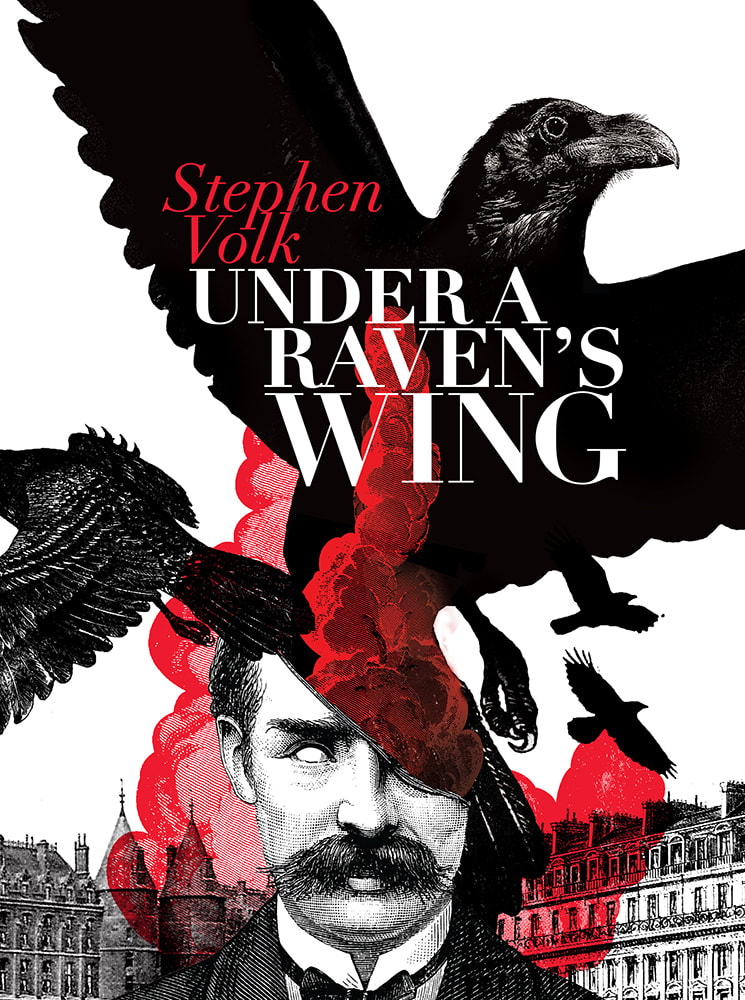
Under A Raven's Wing.


Under A Raven’s Wing
is a new collection of stories by Stephen Volk and is published by PS Publishing. The seven stories contained within this beautifully produced book describe the exploits of a young Sherlock Holmes and his tutelage, in the Paris of the 1870s, by another famous fictional detective C. Auguste Dupin. It’s a marvellous concept bringing together the two men - the veteran and the rookie - with the old master passing on his knowledge and wisdom to the young man at the beginning of his career, and something Sir Arthur Conan Doyle would heartily approve of I’m sure, having acknowledged his own debt to Poe’s detective when creating the character of Holmes.

All of the stories bar one are presented as letters from Holmes himself to Inspector Lestrade, written as the master detective nears the end of his own life; a neat inversion from the original stories in which the narrator was Holmes’ partner in crime(busting) Dr Watson. The final story, the incredibly poignant The Mercy of the Night, is the only one not to follow this format – except it sort of does. The bulk of the narrative is a letter from Dupin to Holmes – which finds its way to Lestrade nonetheless, courtesy of Holmes himself who adds his own correspondence as a coda, giving the whole thing the feeling of a story within a story, a dream within a dream.

I confess, the last sentence of that paragraph was a desperate attempt on my behalf to shoehorn a Poe reference in. And pretty awful it was – unlike those that are distributed about the book itself. There’s much joy to be had at spotting them – some are more obvious than others – and they’re an indication of just how much work has gone into producing these stories. The level of detail is astounding, in particular the recreation of the voices of the two fictional detectives both of which ring absolutely true.

With his wonderful Dark Masters Trilogy, Stephen showed himself a master at placing real people in fictional situations to produce compelling stories and insightful character studies. In Under A Raven’s Wing, he’s flipped that around, placing two fictional creations in real historical settings, populated by real people – including Jules Verne – and set against real events such as the dedication of the Statue of Liberty (a scene in which I believe I spotted an uncharacteristic lapse in the accuracy of Holmes’ recollections…) Jack the Ripper flits through one of the stories but there are nods to famous fictional characters too; the Phantom of the Opera and the Hunchback of Notre Dame also get honourable mentions.

There’s great skill employed then in the creation of this fictional/real world but the key to the success of any crime fiction – which is what this is after all – is in the plots themselves, the crimes which have to be solved. Once again, the author has come up trumps; the mysteries here are ones Poe and Conan Doyle would have been proud of creating themselves – seemingly impossible crimes which are solved by the characteristic application of logic and rationality. Whilst Holmes might be the main subject of the book, the nature of the mysteries he and Dupin solve owe more to the latter’s creator, most strikingly in Father of the Man which involves the plot device of a premature burial (and which is my favourite of the collection).

In truth, the book is an origins story, telling as it does of the apprenticeship of Holmes. As such, it does a marvellous job of inhabiting the character and even provides explanations for, and origins of, many of the great detective’s trademarks; the magnifying glass, the violin – even his drug addiction.

I really can’t express how impressed I was with Under A Raven’s Wing. The stories in here are some of the best to feature the character of Sherlock Holmes that I’ve read – and bear favourable comparison to the originals. It’s proof yet again that Stephen Volk is one of the most creative writers currently plying their trade and also one of the most skilled at his craft. It’s a book I recommend highly.

Monday, 8 October 2018

The Dark Masters Trilogy


The Dark Masters Trilogy is published by PS Publishing and brings together the two previously published novellas, Whitstable and Leytonstone alongside the concluding story in the series, Netherwood. All are written by Stephen Volk, and are fictionalised accounts of episodes in the lives of notable talents in the creative arts, Peter Cushing, Alfred Hitchcock and Dennis Wheatley respectively, the books’ titles originating from the locations in which those events occur.
I’ve already reviewed both Whitstable and Leytonstone – here and here – so this review will focus mainly on Netherwood. The titular location is a boarding house in Hastings, the final residence of the Great Beast himself, the wickedest man in the world, Aleister Crowley and the place to which he summons novelist Dennis Wheatley. Although this meeting is fictional, the two men had actually met in real life some years earlier at the Hungaria Restaurant near Piccadilly Circus, and it’s this prior connection which Crowley, (and the story), exploits. Following the meeting, Wheatley based some of his characters on Crowley – thinly enough that umbrage, or even offence could be taken. Possibly enough that some kind of revenge would seem appropriate…
Perhaps the most notable achievement of the two previous novellas was the degree of characterisation they presented, offering new insights into both Cushing and Hitchcock. Such skill is even more evident in Netherwood with an equal emphasis on both Wheatley and Crowley. Whilst this is a work of fiction, it is - has to be – grounded in fact and the requisite exposition and back-story is presented here in masterful fashion. The novel opens with a scene set on a train in which Wheatley meets a young soldier and his sweetheart, the dialogue – both internal and external – providing the story of Wheatley’s military service in a way that appears seamless and natural. Anyone aspiring author, (and a few established ones), should use this trilogy as a masterclass in developing character. The information is all there but isn’t dumped on the reader, rather it’s presented as part of the natural flow of the narrative, character is revealed by action and interaction. It’s sublime stuff.
It’s a little unfortunate that Wheatley is up against Crowley here; unfortunate in that in comparison to the force of nature that is the most famous member of the Golden Dawn he comes across as a little anodyne. Crowley, however, is a different matter altogether. Despite his frailty, (he was at this point close to death), he dominates every scene; unstable, eccentric, impossible to read there’s a real sense of unease and disquiet whenever he appears. Anyone whose “career” is built on spouting, to all intents and purposes, bullshit, requires a huge amount of charisma to be successful and this was undoubtedly the case with Crowley. Charismatic enough to entice a figure of the establishment such as Wheatley, (a man who is inwardly please that the soldier on the train doesn’t recognise him), to answer his call.
The reason for Wheatley’s attendance turns out to be more than just catching up on old times however. He is there to help Crowley, to face a threat which will be too much for the frail, heroin addicted “beast” to confront on his own. Once again, great skill is shown in presenting the scenario around the threat and the discussions which convince the staid author to participate.
That participation involves the performance of a magick ritual, the presentation of which is yet another highlight of this brilliant novel. As seen through the experiences of Wheatley, it’s a stream of altered consciousness full of graphic and disturbing imagery.
It’s the crowning glory of Netherwood that Crowley’s motivations in involving Wheatley remain ambiguous. The hint of revenge – or spite - suggested earlier may be the case but other interpretations hold equal weight. Redemption is a common theme in conclusions and this too may be the case. Netherwood pours away the snake-oil, revealing the hidden depths to Crowley’s character and it’s possible that a personal tragedy is the driving force behind this final act. Maybe the motivation was his humanity after all.
Humanity – or, more precisely, human nature – has been the underlying theme of all three books in the trilogy. The three books have followed a traditional structure with the second part the darkest by far. A strange claim perhaps, given the black magic and Satanism which is so much a feature of Netherwood but my feelings on finishing this final part of the trilogy were ones of optimism, not least because of the stirring meditation on the nature of art – and artists (another theme of the whole trilogy) – on which it ends.
Each book in the trilogy is a masterpiece. Combined, they produce a kind of synergy, creating an outstanding reading experience. Perhaps their greatest achievement is to provide convincing portrayals of their protagonists despite being fictional accounts, all done through the skill and craftsmanship of the writing. Now that’s real magick.

Monday, 27 March 2017

The Little Gift

One of my favourite things in the world is to read a story and then, once it’s finished, find myself still thinking about it, reassessing and re-evaluating what I’ve read, gaining fresh insights, revealing subtleties which registered only subconsciously on first exposure to the words.
Such was very much the case with the new novella from Stephen Volk, The Little Gift which is published by PS Publishing.
It’s a slim, but beautifully produced (and illustrated), volume and I rattled through it in a single sitting in less than an hour. Its brevity belies its content however as what we’re given here is a tale of massive depth, the words and story undergoing some magical synergy to create a piece of work which stealthily infiltrates your mind, a first person narrative which makes you believe the story is heading in one direction before craftily heading off somewhere completely different.
The first person narrative is absolutely essential to the story. Yes, the narrator is unreliable – but aren’t they all? Narrators (not to say readers) will always superimpose their own interpretations on stories but his unreliability isn’t the most important thing anyway. What the narrative provides here is a beautifully crafted exploration of character. And not a very nice character at that.
It’s difficult to say too much about the Little Gift without giving away key plot developments. Bad things happen, some very bad things happen – both directly and indirectly involving the narrator and it’s his attitudes towards these events which provide the deepest insights into his character.
I chose Stephen’s story The Peter Lorre Fan Club as my favourite of last year because of the skill with which he slowly unfolded the story by means of dialogue alone and there’s as much skill on display here this time using a monologue. Some may find metaphors for society in general in the attitudes of the narrator, but even as “just” a description of a fairly – actually deeply – unpleasant individual, The Little Gift is an outstanding piece of writing.

A week after reading it, I’m still mulling over The Little Gift. It’s a very, very clever piece of writing and I highly recommend you check it out for yourself.

Monday, 12 January 2015

Leytonstone.

Anyone who’s read Stephen Volk’s collection Dark Corners from Gray Friar Press (and if you haven’t – you should) will have enjoyed a story towards the end of the book called Little H. It’s written as a screenplay and describes the (possibly apocryphal) story of how Alfred Hitchcock’s father made him spend a night in a police cell when he was seven to teach him a life lesson and show him what happens to “naughty boys”. That story has now been expanded into a novella and forms the starting point of Leytonstone, the second in the author’s putative Dark Masters trilogy published by Spectral Press.
The first in the series- the sublime Whitstable (which I reviewed here) – focussed on Peter Cushing, set towards the end of the great actor’s life. One of the many joys of that particular book was the references to many of Cushing’s films woven into the text and the subtle way in which they impacted on his character and the same technique is used in Leytonstone although this time it’s the other way round – it’s the real life events experienced by the young Hitchcock which will influence the films he is yet to make.
The screenplay format of Little H isn’t employed for this longer version but the story is written in present tense, a style I personally love and which brings an immediacy to - and an immersion in - the events which unfold.
The incarceration is deeply traumatic and will lead to a life-long fear and mistrust of the police. It’s here the young Hitchcock encounters the policeman who will come to play an even darker role as the narrative unfolds. Perhaps relishing his role of captor a wee bit too much, he uses Jack the Ripper as a cultural reference to further terrify the boy and it’s a strange sensation to realise that the East London serial killer only ended his reign of terror some fifteen years before the events described here. It’s incredible to think that someone so associated with the “modern” art form that is cinema was born in the nineteenth century, the Victorian age.
As profound as the experience is, it’s Alfred’s behaviour afterwards (or at least Stephen’s version of them) that define the man who is to come. It would have been incredibly easy to shoehorn in a load of overt visual references, hinting at the films to come (Alfred attacked by a flock of crows, Alfred breaks his leg and is confined to a wheelchair…) but it’s a credit to Stephen’s skill as a writer that the seeds are sown in the most subtle way.
Yes, there’s a Hitchcock Blonde (though her hair is described as yellow) but it’s the themes of the films to come rather than direct references that are highlighted here – the voyeurism that was a major feature many of his films, the disdain he reputedly showed towards others, actors particularly. It may be another myth that Hitchcock described actors as cattle but based on the character drawn here it would be an entirely believable comment.
It has to be said that the Alfred Hitchcock on display here is not a sympathetic character. Truth to tell he’s pretty horrible. Context for this is provided by his parents, characters beautifully drawn by the author, his father in particular – a man for whom it seems expressing any kind of emotion is an impossibility. (It’s pertinent that it’s emotional support his mother desperately craves). Yes, the main thrust of the narrative is Alfred but this is definitely an ensemble piece and the book works so well because as much care and attention is given to the other characters and their narratives as to the young Hitchcock.
As befitting the second part of any trilogy, Leytonstone is dark and certainly lacks the optimism and uplift of Whitstable. It is an incredible piece of writing though and one which will be appreciated by those with a less than encyclopaedic knowledge of Hitchcock’s films as much as those who do. It is with much anticipation I await the third of the trilogy, whose subject and title remain to be seen. (My money’s on Bramshott though).

Leytonstone has the makings of another classic. Befittingly (given the overt influence Catholicism had on Hitchcock’s life), Stephen has proven the claims of the Jesuits by taking the boy at seven and giving us the man. It’s a book I highly recommend. You can buy it from the Spectral Press website here.

Tuesday, 15 October 2013

Monsters in the Heart.

Stephen Volk's versatility as a writer has perhaps never been better demonstrated than by two of his stories published this year. This is the writer behind the elegiac, moving tribute to Peter Cushing that was Whitstable and also the masterclass in gross-out, the outrageous Arse Licker. Both were - for very different reasons - brilliant pieces of writing so it was with much anticipation that I looked forward to the release of his latest collection of stories, Monsters in the Heart from Gray Friar Press. There are fifteen stories in the collection, two of which are brand new and not previously published.
The first story is After the Ape which I'd already encountered in the Never Again anthology. I was blown away by it then, by its originality and imagination and was similarly affected on this second reading. Centering around events after the fall of King Kong from the Empire State Building it merges real life horror (and political comment) with iconic fictional characters to produce a - frankly - stunning piece of writing.
The death of another fictional icon is the starting point for Hounded another highly imaginative piece using the character of Dr Watson, here attending a seance after the death of Holmes and inadvertently releasing something terrible in the process (the title of the story providing a clue as to what that might be...)
There is much variety within the fifteen stories, in style and content. Some read like fables (Swell Head, Fear) whilst others touch on the surreal (Easter, Air Baby). There are "real" monsters, Monster Boy is an affectionate tribute to those created by the movies whilst Appeal For Witnesses updates an ancient mythology into a police procedural that put me in mind of some of Joel Lane's stories. In White Butterflies and Notre Dame the monsters are all too human, whether through violence and aggression or religious intolerance.
Who Dies Best provides a satirical look at the movie making business with a novel approach to filming death scenes whilst the immensely disturbing In The Colosseum uses inner city violence and voyeurism to deliver a blistering attack on the current state of TV broadcasting.
Pied a Terre is a ghost story but ironically is the one I enjoyed the least. In his notes, Stephen acknowledges the risks he took in writing the story, that offence could be taken. I wasn't offended but did feel slightly uncomfortable reading it. Good horror should make the reader uneasy, just not like this...
The Hair is a good old fashioned horror yarn, a tale of voodoo rituals leading to a conclusion that's truly horrible. And which, when you think about it a wee bit more, becomes even more horrible.
A Paper Tissue is possibly the least overtly horrific story in the book but which for me was the highlight of the collection. There's nothing supernatural in this tale of a couple holidaying in Italy but the writing is superb, a perfect description of a relationship that's failing until a chance encounter changes everything. The conclusion of the story is truly unsettling - subtle but deeply disturbing.
Monsters in the Heart is a marvellous collection. Imaginative, intelligent writing from a master craftsman. Highly recommended.

Sunday, 2 June 2013

Whitstable.

Whitstable, written by Stephen Volk, is the third novella in the Spectral Visions series published by the consistently wonderful Spectral Press. As with the previous novellas, it's a beautifully produced product, the limited edition hardback a real collector's item.
The story is set in 1971 and is a fictionalised account of an episode in the life of Peter Cushing following the death of his beloved wife Helen. It begins with Cushing a broken man, overwhelmed by grief and the writing in these opening pages is so, so powerful, capturing perfectly the conflicting emotions of a man who has lost the love of his life, his raison d'etre,  unwilling - unable even - to move on with his life. It's beautifully written but heart-breaking, made all the more poignant by the fact that this is the description of a man everyone who reads this book knows, or at least knows of. Everyone will have their own impressions of Peter Cushing and it's a fairly safe bet that the majority will hold him in great esteem, a true gentleman who brought gravitas, dignity even to every part he played. Even at a young age I was aware of this, often using it as a counter-argument to my parents whenever they expressed concerns at the type of film I was watching and so obviously enjoying. "But Peter Cushing's in it," I would reply, "he's a proper actor..."
A chance encounter with a young boy on the beach (Carl Drinkwater, a name with resonances to Carl Bridgewater, another young boy with a tragic childhood in the seventies) provides the catalyst to pull the actor from the decline into which he's fallen. Making the assumption that Cushing is in face Van Helsing in real life, the boy asks him to deal with the "vampire"- his mother's new boyfriend - who "visits at night-time" and "takes his blood" - a naïve interpretation of events that both Cushing and the reader know refers to something much more disturbing.
At one point, Carl says "I can't move. I'm heavy and I've got no life and I don't want to have life anymore." It's almost a perfect summation of how Peter Cushing is himself feeling - and may be the impetus for his decision to help the boy but Stephen Volk skilfully "hides" the words in the middle of a section of dialogue, subtly adding it in without drawing attention to it. It's a masterful piece of writing.
The narrative of the novella then describes the newly galvanised actor's investigation of, and ultimate confrontation with the boy's tormentor, that confrontation occurring first at a market (where Cushing claims the man's sole) and then in a cinema in a cleverly written dialogue set against descriptions of the film playing on screen, Cushing's own The Vampire Lovers.
Whitstable was a joy to read, it's a perfectly pitched character study and Stephen Volk's admiration for the actor shines out from the pages. The period detail is lovingly created and rendered and references to the actor's body of work are plentiful without being a distraction. At times it's unbearably sad - a reference to the Morecambe and Wise show of all things brought a lump to my throat - but ultimately it's an uplifting experience and a fitting tribute to the great man.
As an actor, Peter Cushing battles countless on-screen monsters. This battle with an all too human monster, and his own personal demons, makes Whitstable an instant classic.